
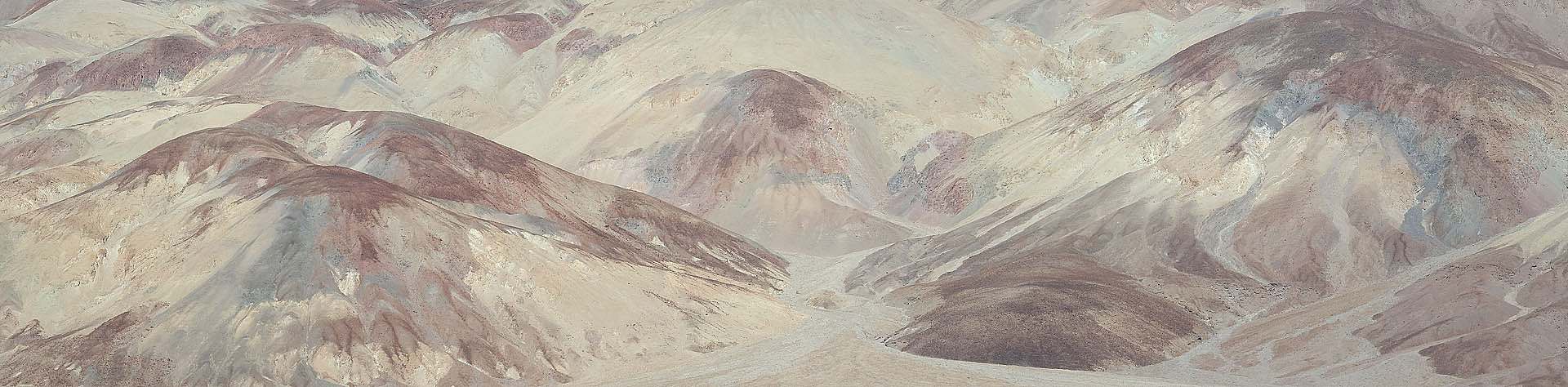
When these rare and fleeting moments arise, they turn landscapes into ethereal paintings. Being in the right place at the right time requires careful planning and even more patience. Most important, however, is the mindful awareness for such fleeting instants.
Death Valley, in southeastern California, is notorious for its relentless heat, with the sun radiating from a cloudless sky. For this reason, it is especially advisable to avoid the landscape during midday in the summer months. Even in April, when this image was captured, the heat was already unbearable, yet it was necessary to scout a location intended for sunset. Amid the dazzling light, standing on the salt flats of the dried Lake Manly, a locally confined dust storm formed in the distance.
When the heat rising from the salt flats shimmers and cooler downslope winds from the surrounding mountains flow into the valley, a unique interplay of light, air, and dust occasionally emerges. As the heated air near the ground meets the cooler air descending from the steep mountain slopes, swirling air currents lift from the surface and rise in slender, twisting columns. From the collision of these temperature and pressure contrasts, a rotating updraft develops, carrying dust and sand aloft. What begins as a local vortex can extend across the valley as a drifting veil of dust, which — as in this instance — enveloped the valley slopes in diffuse light. The sun was momentarily dimmed just enough to create this ephemeral mood of a painting. Once the dust veil passed, the harsh, high-contrast sunlight returned, erasing the scene’s fleeting magic.
This landscape belongs to the so-called Badlands: highly eroded sedimentary formations shaped by time, water, and tectonic uplift. The deposits consist of clay-rich muds, gritty sands, volcanic ash, and silt — sand and clay nearly ground to dust. These sediments date back to the late Pleistocene, the age of the ice ages. The Badlands were formed as part of extensive alluvial fans created by episodic rainfall, which transported gravel, sand, and salts from the surrounding mountains into the valley. During dry periods, the remaining layers are porous, crumbly, and deeply furrowed. Their captivating colors derive from minerals: iron oxides tint the sediments red, green, and brown; clay minerals produce gray, bluish, and violet hues; while the black-gray tones indicate basalt from volcanic eruptions.
During glacial cycles, Death Valley was part of a vast lake — Lake Manly — which once covered the region until roughly 10,500 years ago. As the lake dried in the heat, salt was left behind, forming the landscape we know today.
For this fleeting moment, one of the most inhospitable places on Earth reveals a tenderness all its own. True beauty never demands attention — it reveals itself. Quietly, subtly, only to those willing to be attentive and breathe with Earth. In such moments, the desert becomes a mirror of time: geological depth, shifting climates, and ancient lakebeds — and in turn, a mirror of ourselves. A reminder that everything is intertwined, and that we breathe together with this living planet, in this canvas of light and geology.