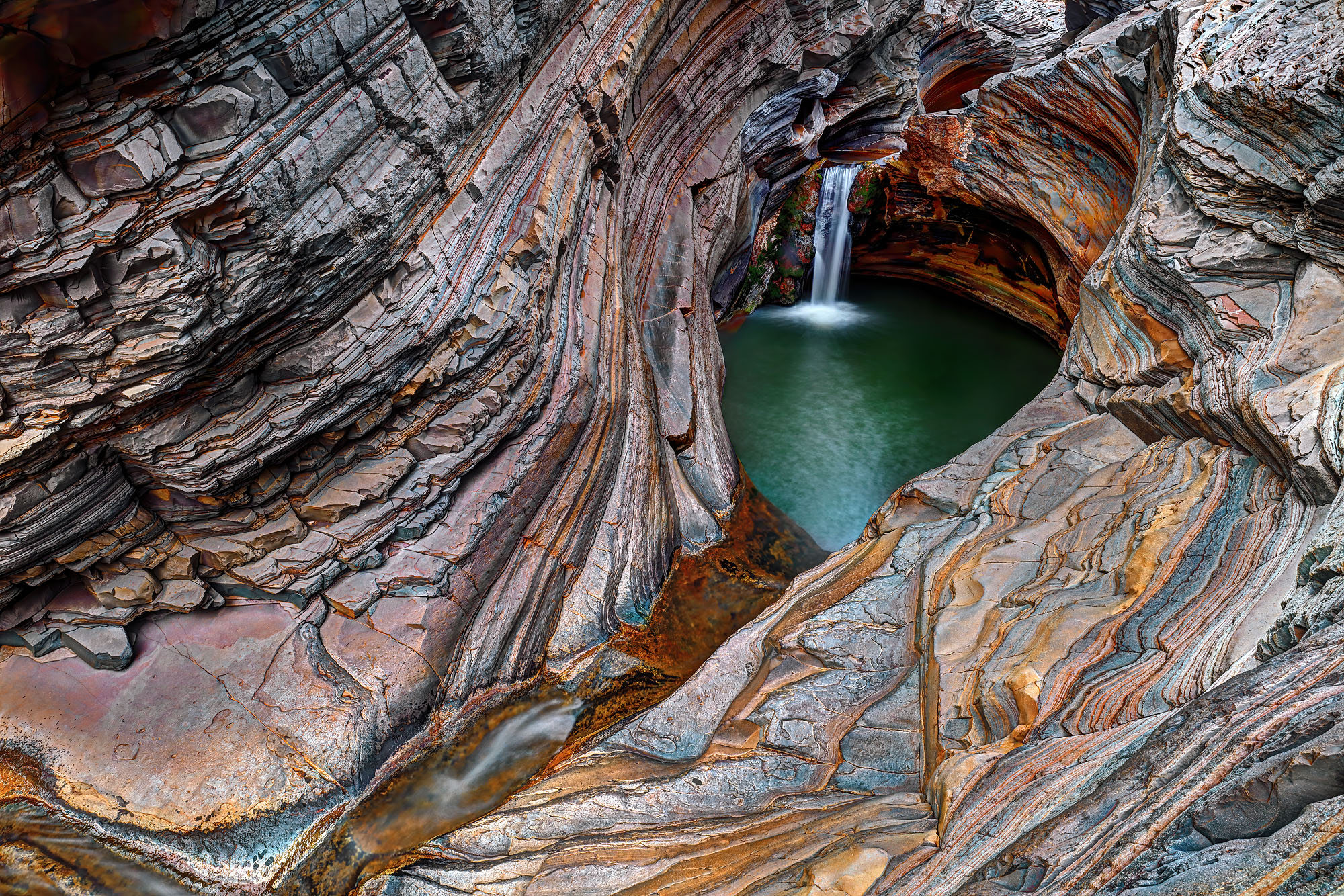
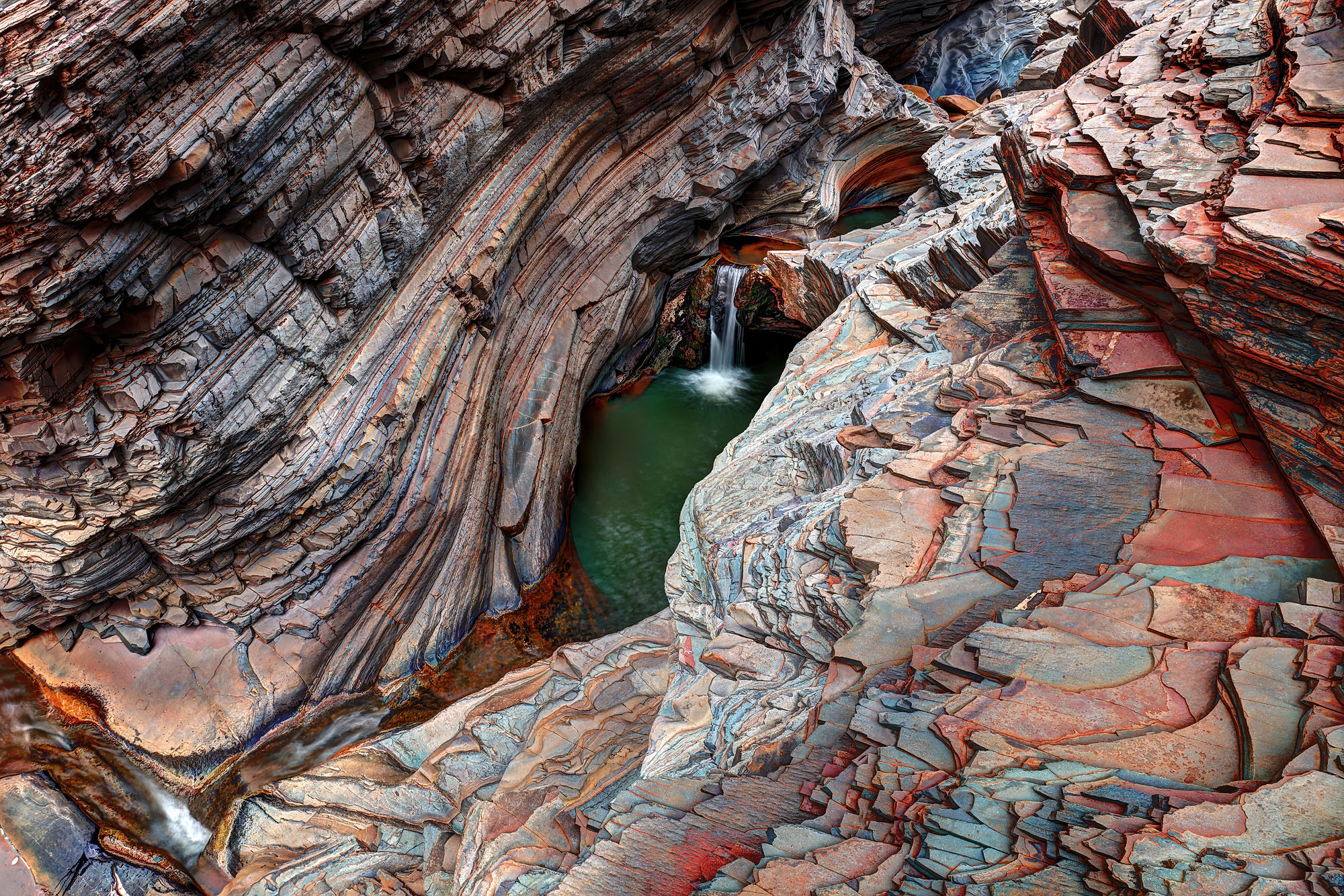
The banded iron ores of Hamersley Gorge in Karijini National Park in northwestern Australia date back to the archaic epoch of our planet. About 2500 million years ago, these layered banded iron sediments were deposited at the bottom of a shallow sea. Bacteria played a decisive role in this process. They had the ability to oxidize the iron dissolved in seawater, causing it to precipitate onto the seafloor as rusty mud. The distinctive feature of these bacteria was that they managed to do so in the absence of free oxygen in the deeper ocean through anoxygenic photosynthesis. At this time, the shallow marine environment contained only small amounts of free oxygen. This free oxygen was produced by cyanobacteria, the blue-green algae that were the first to utilize oxygenic photosynthesis. In doing so, they additionally helped oxidize the iron in the seawater.
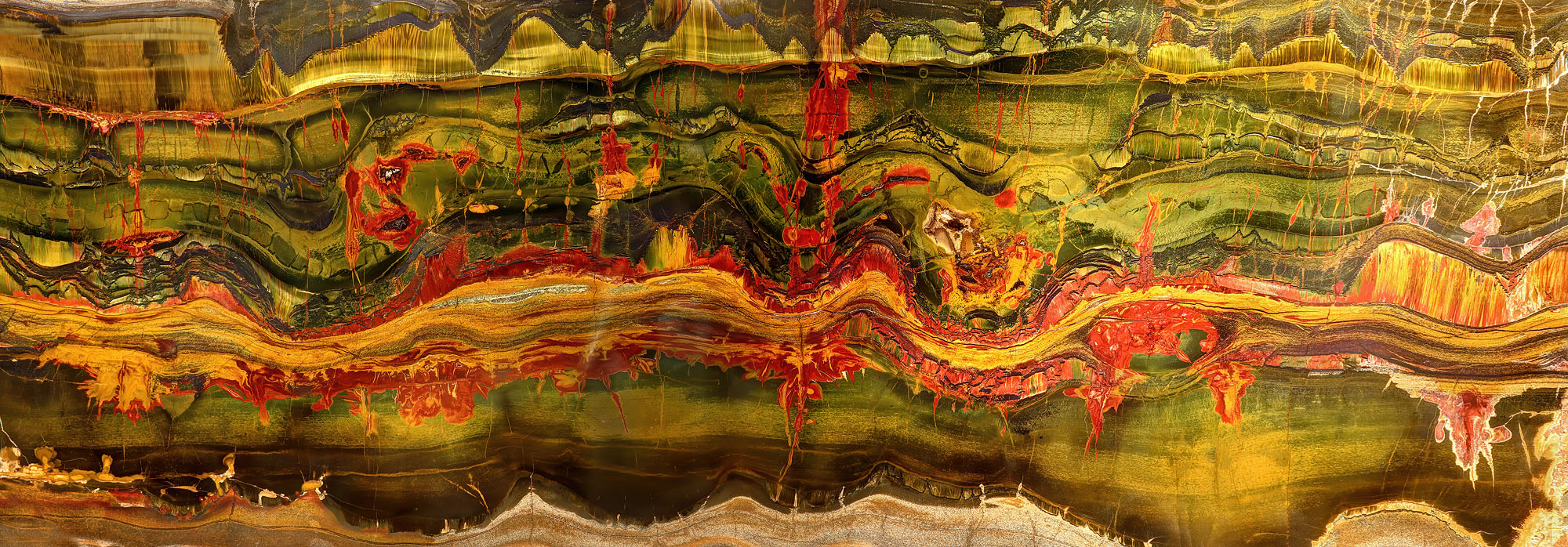
The colorful rock layers are preserved horizontally, just as they were deposited billions of years ago. This is strikingly remarkable because it implies that these banded iron ores have hardly changed at all since their formation 2500 million years ago. The relentless tectonic forces that have continuously reshaped the Earth ever since left this part of the planet almost pristine. Only a few undulating, wave-like folds can be seen in the rock, but the strata never fractured.
The individual rock layers vary in thickness from millimeters to decimeters and differ in color from layer to layer, depending on their iron content and the mineral assemblages they contain. Dark layers ranging from intense red to bluish-gray tones contain high iron concentrations and alternate with lighter-colored layers consisting mainly of microcrystalline quartz, known as chert or hornstone.
During phases of increased submarine volcanic activity, large amounts of iron were released from the mid-ocean ridge and transported by upwelling ocean currents onto the shallow shelf seas of the Pilbara Continent. During these periods, the iron-oxidizing bacteria thrived and thus created the dark, rust-colored layers. During quiescent periods of volcanic activity, or when ocean currents were unfavorable for transporting dissolved iron, the lighter chert layers were deposited because the seawater was saturated with silica. Neither process occurs today. Today, the biologically produced oxygen released into the atmosphere and the ocean prevents the presence of dissolved iron in seawater. Moreover, numerous marine microorganisms consume vast amounts of silica to produce their skeletons. After their death, these tiny skeletons sink to the bottom of the ocean. This process is a very effective biological removal of silica.
The thinly banded iron ore layers can be traced horizontally over hundreds of kilometers. Therefore, the deposition must have taken place under calm and stable conditions over a very long period. This also requires a water depth of at least 200 m (650 ft) in the warm, shallow seas of the continental shelf, as otherwise storm-wave events such as typhoons would have dispersed and mixed the sediments. Bioturbation by animals did not yet exist.
The deposition processes could have taken up to 350 million years, with a sedimentation rate of about one millimeter per year. Due to the load of the sediments and the resulting high pressure and temperature, the muddy layers slowly solidified and turned into rock. In the meantime, mineral assemblages and sodium-containing solutions penetrated the rock layers along microscopic veins and relocated the minerals. This resulted in the rich coloring of the banded iron ores, which reach a thickness of up to 500 m (1640 ft) in Karijini National Park.
The gorges of Karijini cut into these extremely old strata only a few million years ago. The reason was a mild collision between the Australian and Pacific plates, which caused the entire Pilbara Block to uplift slightly. This uplift created vertical cracks in the strata that weakened the rocks and allowed streams and creeks to slowly incise into this archaic landscape. Seasonal thunderstorms produce torrential rainfall and flash floods that effectively erode the landscape. Over a period of about 20 million years, this created the mesmerizing gorges of Karijini, including the spectacular Hamersley Gorge and its beautiful Spa Pool.