
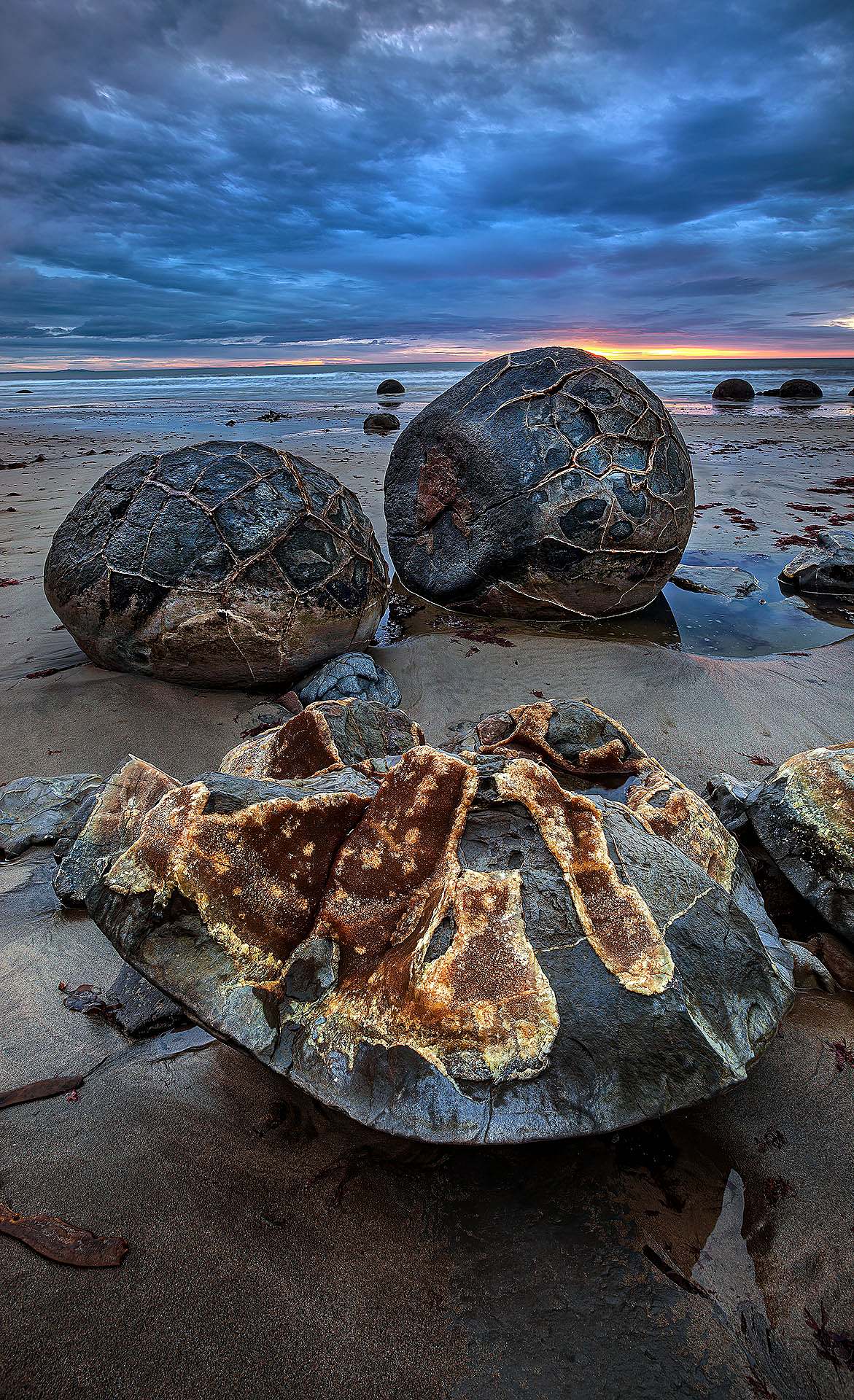
At sunrise, the beach at Moeraki on the east coast of New Zealand’s South Island is bathed in delicate pastel light. The shoreline is dotted with the remarkable Moeraki Boulders—giant stone spheres that seem almost too perfect to be natural. They are the remnants of a long-lost world, a geological story slowly unfolding before our eyes.
In the foreground, a broken boulder reveals its breathtaking interior. Golden veins of calcite weave through an intricate network of fractures, exposing a hidden masterpiece that formed in darkness beneath the seafloor over millions of years, shortly after the extinction of the dinosaurs. It is a geological painting, illuminated by the softest light of early morning.
The Moeraki Boulders are not ordinary rocks rounded by the surf. Instead, they grew into their remarkable spherical shapes through a process known as concretion. Around 60 million years ago, this coastline lay beneath a shallow sea, when Zealandia—the nearly submerged continent of which New Zealand is a part—was still largely hidden beneath the waters of the Pacific.
Zealandia is one of Earth’s most extraordinary, yet least-known, continents. More than 90 percent of its surface lies beneath the Pacific Ocean. A drowned continent whose true nature has only been recognized in recent decades. While the deep ocean floor is composed of dense volcanic basalt, Zealandia is built upon continental crust made of lighter rocks such as granite and gneiss. It is a surviving fragment of the ancient supercontinent Gondwana.
About 85 million years ago, this immense block of continental crust began to break away from eastern Gondwana. As the crust stretched and thinned, Zealandia gradually subsided over millions of years. Eventually, most of the continent disappeared beneath the Pacific, yet it never lost its continental identity.
Within the fine muds that accumulated in these ancient marine basins, tiny fragments of shells, plant material, and bones became the seeds of an extraordinary geological process. Around these minute nuclei, calcite crystals precipitated from mineral-rich pore water within the sediment, growing outward in every direction, layer upon layer, for more than four million years. In this way, nearly perfect stone spheres formed beneath the seafloor, reaching diameters of up to three meters (10 feet) and weighing as much as seven metric tons. They grew from the inside out, layer by layer, remaining hidden beneath the seabed for nearly 60 million years before finally emerging into daylight.
As the concretions continued to harden, fine shrinkage cracks developed within them. Over time, these fractures filled with golden calcite, creating the intricate patterns that define what geologists call septarian concretions. This remarkable work of geological art remained completely hidden for millions of years.
Then, about 25 million years ago, renewed tectonic movements along the boundary between the Pacific and Australian plates began lifting parts of Zealandia back toward the surface, shaping the landscape of New Zealand’s South Island as we know it today. Relentless waves gradually eroded the surrounding soft marine sediments, exposing the far more resistant concretions, which eventually rolled onto the beach. As pressure was released during uplift and erosion, some of these stone spheres split open along natural planes of weakness, revealing the astonishing beauty that had remained hidden within.
The Moeraki Boulders tell two stories at once. They reveal the hidden geological processes through which tiny organic fragments grew into magnificent stone spheres over millions of years. At the same time, they preserve the memory of a continent that has almost entirely disappeared beneath the ocean.
Within their interiors they carry the traces of time, pressure, and transformation. Like the exposed hearts of a nearly vanished continent, they remind us that even the most enduring landscapes are only fleeting moments in the great biography of Earth.