
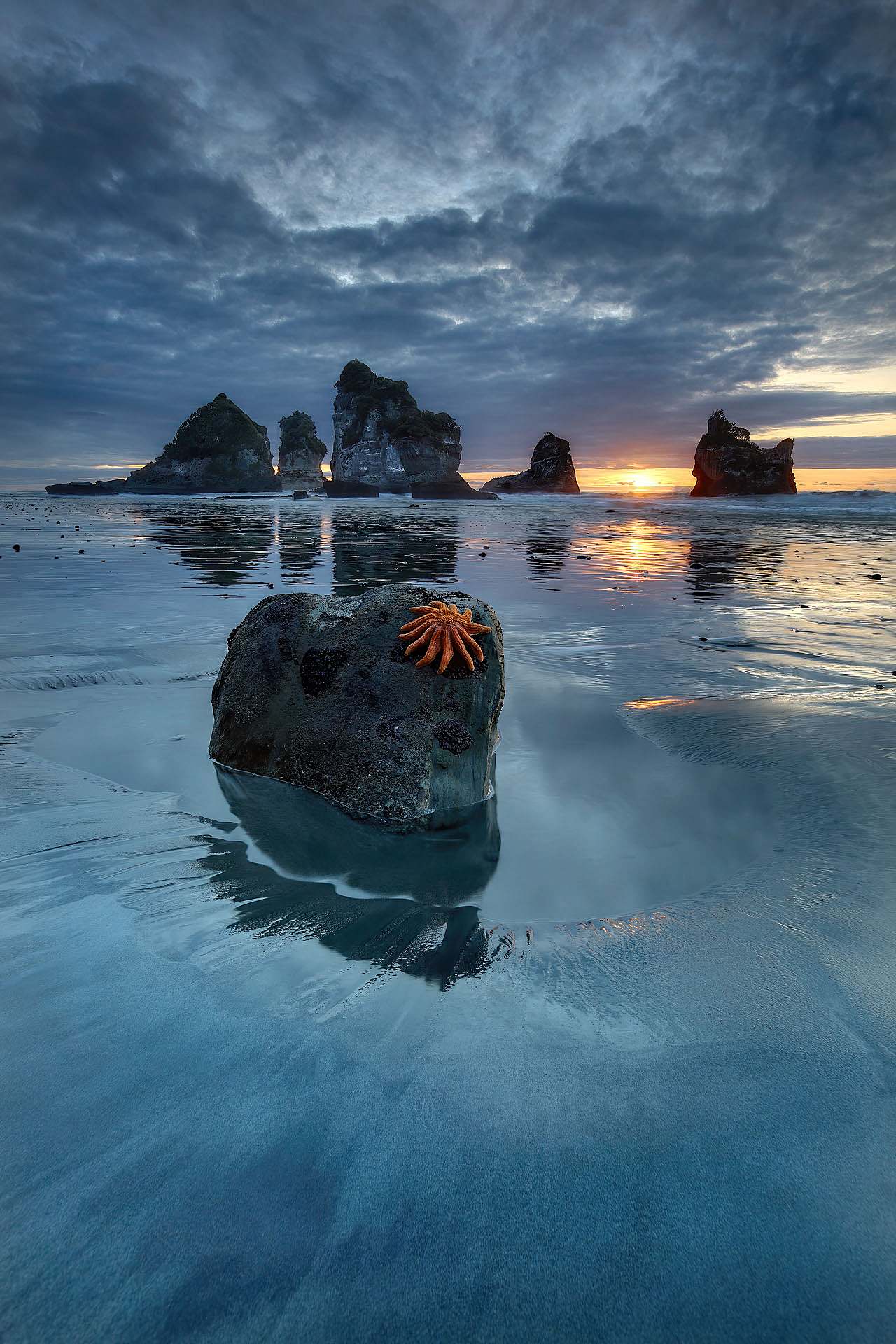
At Motukiekie Beach along the west coast of New Zealand’s South Island—where the tall waves of the Tasman Sea roll with wild force against the rugged cliffs and jagged rock spires—sits a single reef star, Stichaster australis, known to the Māori as Pātangaroa, resting on a boulder worn smooth by water and endless time. The twilight casts a magical light over the landscape, creating an intimate connection between ocean, atmosphere, and life. In the distance, the towering sea stacks of this extraordinary coastline stand as geological monuments to the ongoing interplay between wind, waves, and shifting tectonic plates.
These reef stars are part of the sun star family and, with their ten to twelve arms, are striking creatures that radiate an ancient presence. They belong to the class Asteroidea, an evolutionarily very old group whose ancestors populated the world’s oceans some 400 million years ago. In the tidal pools and rock platforms of Motukiekie, Stichaster australis finds perfect conditions: abundant prey such as sea urchins and barnacles, cool nutrient-rich water, and a habitat continually renewed by strong tidal forces. Its presence tells of ecological resilience in an environment that is anything but geologically stable.
This coast is located within one of the planet’s most significant tectonic structures: the Alpine Fault, a powerful transform fault that cuts almost north-south across New Zealand’s South Island. Here, the Pacific and Australian plates slide past one another at a rate of three to four centimeters per year, like two giant jigsaw pieces. At the same time, there is a vertical uplift component of up to one centimeter annually, contributing to the formation and ongoing rise of the Southern Alps. With every sudden slip, sometimes producing strong earthquakes, the land is torn, deformed, and reshaped.
The dramatic cliffs of Motukiekie reflect these tectonic tensions: uplift, erosion, and displacement sculpt a mosaic landscape that evolves over millions of years in both slow, creeping movements and abrupt shifts. While the crust slides past, the sea relentlessly pounds the ever-changing coast—and somewhere in between, this star clings to its rock, undisturbed by the forces moving the world’s interior.
Perhaps the sublime beauty of this scene is in this very combination: a being whose lineage predates the landscape itself, living in perfect symbiosis with an environment in constant change. Not a star in the night sky but one that rests upon a stone—and reminds us that change and persistence are simply two sides of the same story.