
The total solar eclipse of August 12, 2026, over Mallorca had only just ended. For one minute and 36 seconds, darkness had fallen while the Sun still hung a hand’s breadth above the horizon. Venus had blazed brilliantly in the sky as the Moon completely covered the Sun. Then came the diamond ring, and daylight returned. In the fading light of dusk, the slender solar crescent became a spectacle in its own right. The clouds through which the corona had shimmered moments earlier largely dissolved. Scattered bands of cloud began to glow red, and fifteen minutes later, the Sun set for a second time. This time, not behind the Moon, but behind the horizon.
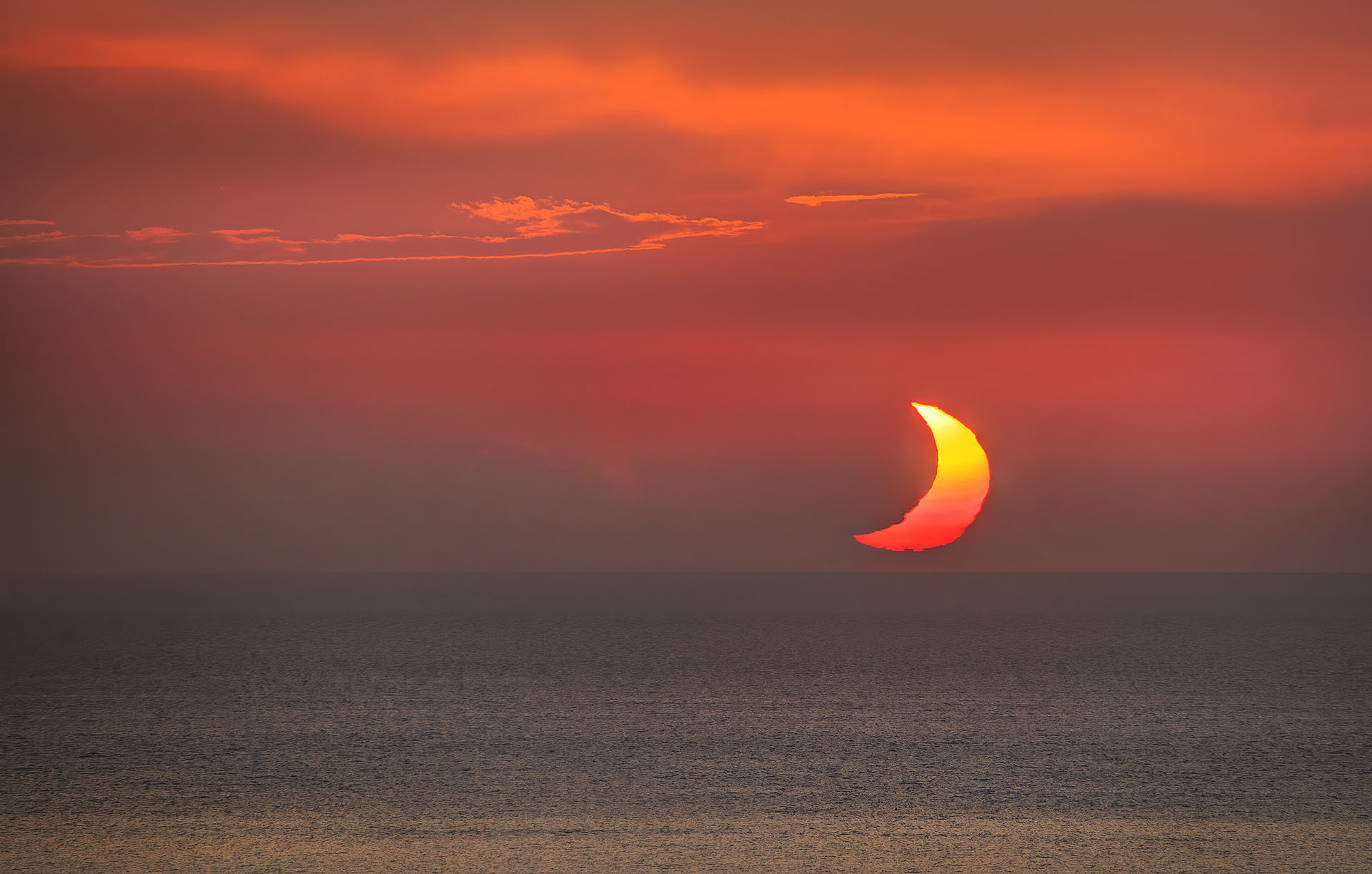
At 8:46 p.m., the Sun touched the horizon and appeared to sink into the Mediterranean, an illusion of perspective. Bathed in pastel evening light, the partially eclipsed Sun gleamed as a slender crescent. Mallorca, the Tramuntana Mountains, and the sea lay beneath a sky that still seemed to hold the extraordinary colors of the eclipse.
The narrow crescent had taken on a remarkable shape. At either end, its tips curved outward like the glowing horns of a tiny flame suspended above the Mediterranean. Yet its edges were neither smooth nor sharply defined. Sun and Moon seemed as though invisible forces had undone their perfect geometry.
Astronomical precision meets atmospheric chaos. This apparent disorder, however, has a physical explanation. Near the horizon, sunlight must travel an exceptionally long path through Earth’s atmosphere. The lower the Sun sinks, the farther its light must pass through the dense layers of air near the surface. Along the way, the rays encounter constantly shifting variations in temperature, pressure, and density. These small-scale differences in atmospheric refraction make the Sun’s outline shimmer, ripple, and fray.
Sun and Moon seem to dance together, a cosmic performance choreographed by Earth’s restless atmosphere. The Moon itself remains hidden; only its passage across the Sun betrays its presence, its dark disk completely overwhelmed by the dazzling light of the slender solar crescent.
And as the Sun slowly sinks into the Mediterranean, something extraordinary happens again: two sunsets in just fifteen minutes. Then the Sun touches the sea. Bit by bit, the glowing crescent slips below the horizon until its final red spark vanishes. The impressions of that day, however, have been etched forever into the hearts of those who witnessed it.
My cordial thanks for finding just the right gap in the clouds in just the right place go to my inner circle: Tala Mohajeri, Gabi Retzkowski, Annika Beck, Tanja Mihailovic, and Christina Heinemann. My warmest thanks also go to the photography team on location, Dr. Frank Paul and Alex Meier, as well as Laura Janina and Alan Majsik, who provided invaluable support and carried the many tripods across the rugged terrain.