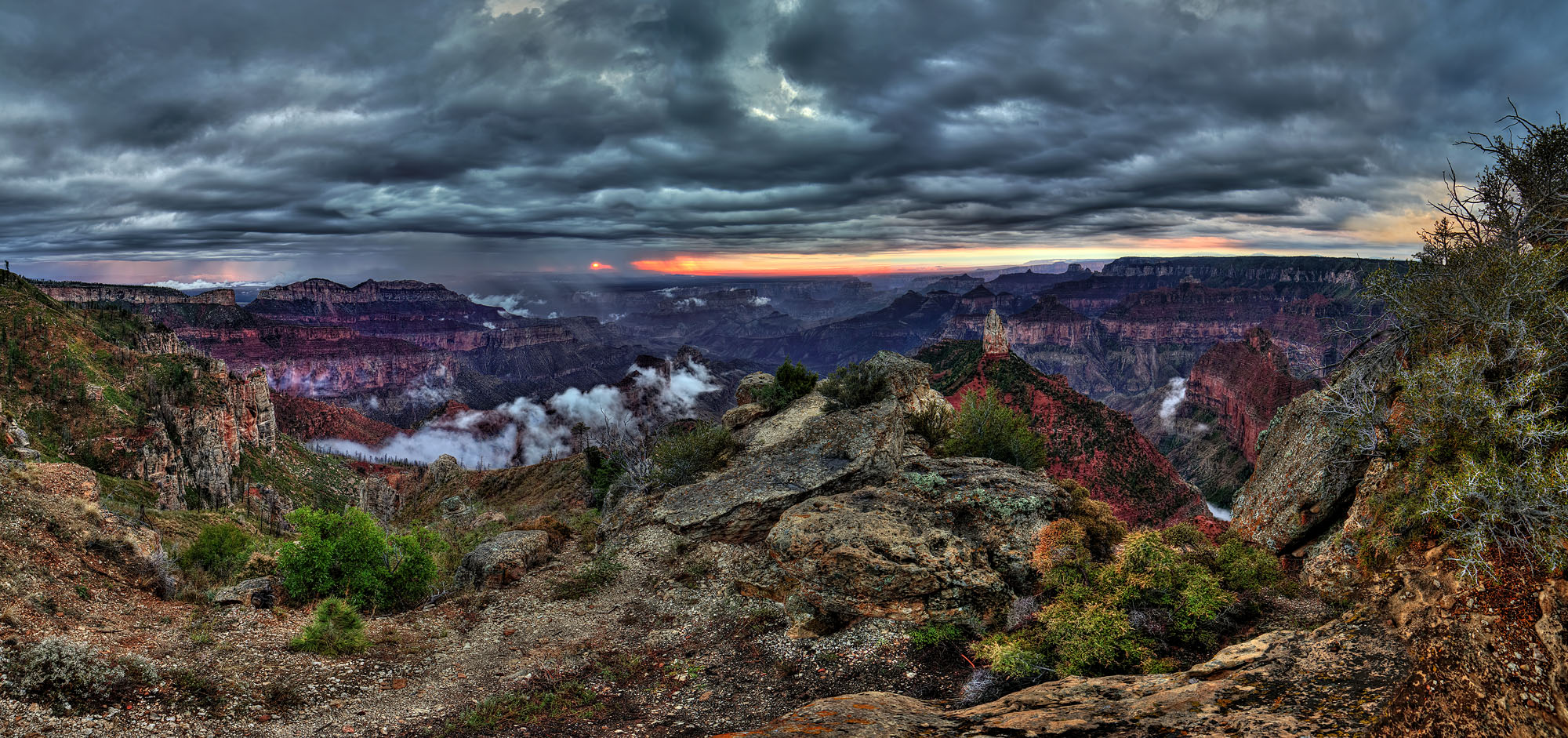
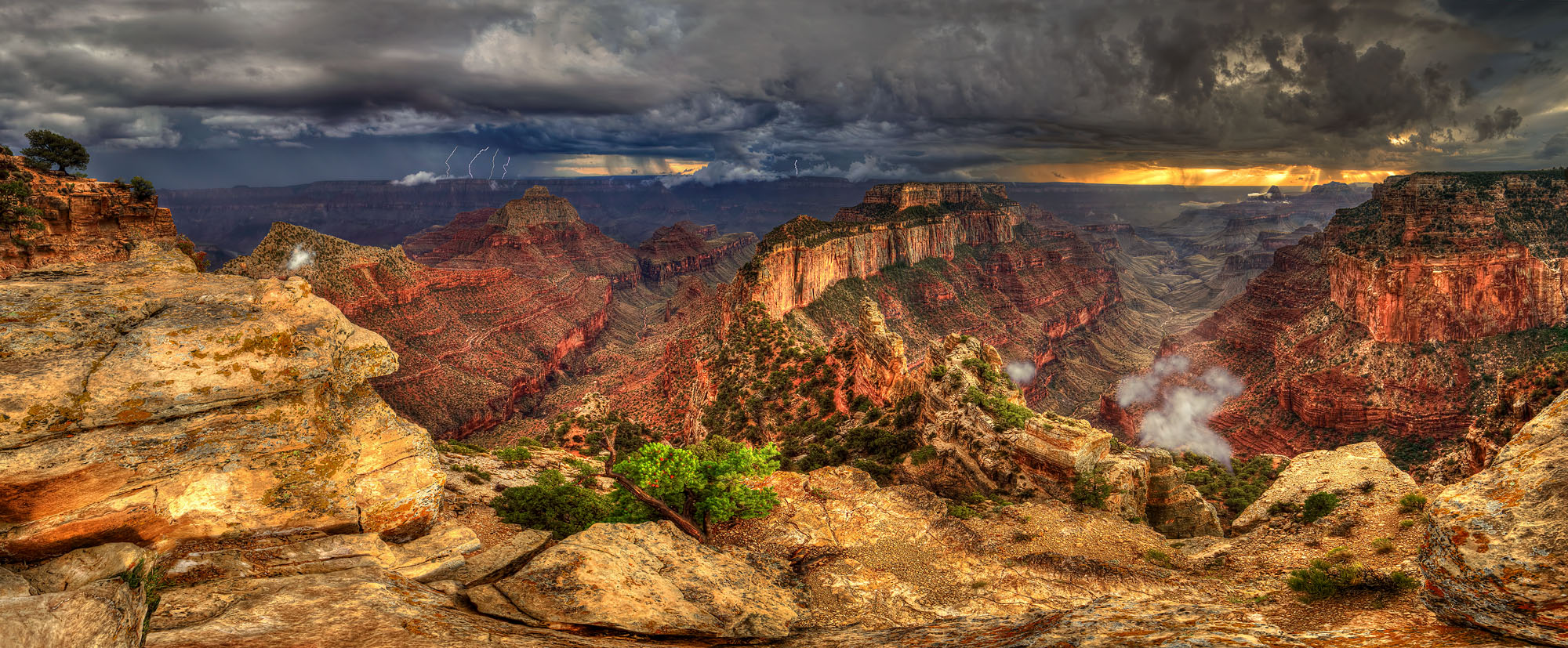
It is an overwhelming adventure, a time of wonder with light and thunder, to witness a monsoon thunderstorm wave rolling across the Grand Canyon at sunset. Surrounded by storm cells, torrential rain and lightning striking far too close behind me, I was deeply impressed by the multiple echoes of the rolling thunder. The panoramic view from the North Rim of the Grand Canyon near Cape Royal extends from Vishnu Canyon past Wotan’s Throne into the sunset over Clear Creek Canyon. The streams that give these canyons their names cascade muddy-brown torrents of stormwater toward the Colorado River, visible through the gap in the rocks at the far left. The South Rim lies 16 kilometers (10 miles) away on the opposite side of the Grand Canyon.
The monsoon season in Arizona lasts from mid-June to mid-September. Yet high temperatures and blue skies are more often than not the defining features of this season. This apparent contradiction is known as the monsoon break in the southwestern United States. Between these dry spells, highly active monsoon waves can develop in irregular cycles. The combination of dramatic clouds, torrential downpours and lightning creates spectacular weather conditions, albeit often only for a brief period.
The spectacle at the Grand Canyon becomes truly awe-inspiring when the setting sun illuminates the storm from below. But how do these weather conditions develop?
Prevailing winds in the southwestern United States generally blow from the west. Moist air arriving from the Pacific Ocean usually loses most of its moisture as it rises over the Sierra Nevada in California, whose peaks rise above 4,000 meters (13,000 feet). Leeward of the mountains, warm and extremely dry conditions prevail, helping to create the arid desert climate of Arizona.
During the monsoon season, however, the winds more frequently shift to southerly directions. This allows humid subtropical air from the Gulf of California and the Gulf of Mexico to penetrate deep into the southwestern United States. When this moist air reaches the highlands of the Colorado Plateau, the terrain forces it upward, causing it to cool. The North Rim of the Grand Canyon rises to 2,683 meters (8,803 feet). In general, as long as no clouds have formed, air temperature decreases by about 1°C per 100 meters (5.4°F per 1,000 feet) as an air mass rises. By the time the air reaches the North Rim, it has therefore cooled by as much as 26.8°C (48°F).
Warm air can hold considerably more moisture than cold air. In warm, unsaturated air, water molecules exist as an invisible gas called water vapor. As the air continues to rise and cool, its relative humidity eventually reaches 100 percent. The water vapor then condenses into tiny droplets, forming clouds.
The Grand Canyon cuts 1,800 meters (5,900 feet) deep into the Colorado Plateau. As a result, the canyon bottom, where the Colorado River flows, can be up to 18°C (32°F) warmer than the North Rim. During summer, the sun also heats the inner canyon much more efficiently than the elevated plateau. The hot, dry air begins to rise from the canyon in the form of thermal bubbles. When these rising currents reach the rim, they collide and mix turbulently with the cooler, moisture-laden monsoon air.
Within the powerful updrafts, the air cools rapidly. More and more cloud droplets form and freeze at altitudes above 10 kilometers (6 miles), creating towering thunderclouds with characteristic anvil-shaped tops. The rapidly growing ice particles eventually become too heavy for the updrafts to support. As they fall, they melt in the warmer air below, and heavy rain begins to pour down. Sometimes, however, the air near the ground is so dry that the falling raindrops evaporate before reaching the surface. The resulting streaks of precipitation that disappear before reaching the ground are known as virga.
The violent collisions and friction among turbulent air, ice particles and water droplets separate electrical charges within the storm cloud. Lightning is the spectacular discharge that restores the electrical balance.
Under favorable conditions, powerful thunderstorms develop as these different air masses collide. Individual thunderstorm cells can then organize and merge into a larger squall line.
It is impossible to predict exactly when, where or how frequently individual thunderstorms will develop. Photographing a thunderstorm over the Grand Canyon at sunrise or sunset therefore requires either extraordinary luck or enormous patience and perseverance. Monsoon waves, by contrast, are larger-scale weather systems that can be forecast up to two days in advance. Even then, however, the exact time and location of thunderstorm formation remain unpredictable because these extensive monsoon waves consist of numerous individual multicell storms.
Monsoon waves therefore greatly increase the chances of encountering the desired thunderstorm conditions. Restricting the opportunity to sunrise or sunset, however, reduces that probability considerably. In August 2018, the monsoon break lasted for three weeks, during which the sky remained mostly clear or partly cloudy. The forecast for this particularly intense monsoon wave became reliable only one day in advance, and the entire weather event lasted exactly 24 hours.
The chance encounter between the magnificent beauty of the Grand Canyon and the elemental forces of a monsoon storm becomes even more profound when viewed against the immense age and geological history of its rocks. The yellow sandstones along the canyon rim are about 250 million years old and were deposited in a shallow sea near the coast. The canyon walls around Wotan’s Throne expose marine sediments about 500 million years old, containing fossils of some of the earliest animals ever to crawl across the ocean floor. Far below, where the Colorado River flows, the rocks reach back to a time when bacteria were the only inhabitants of Earth. These rocks are an astonishing 2 billion years old and consist of alternating layers of sediment and volcanic lava.
Witnessing this magnificent scenery at sunset, surrounded by active thunderstorm cells and lightning striking in the immediate vicinity, was an unforgettable experience. Moments of such profound sublimity awaken deeply rooted connections to our home planet. They stir something instinctive within us and bring with them the irreversible realization of how unique our planet is—and how intimately we are connected to it.