
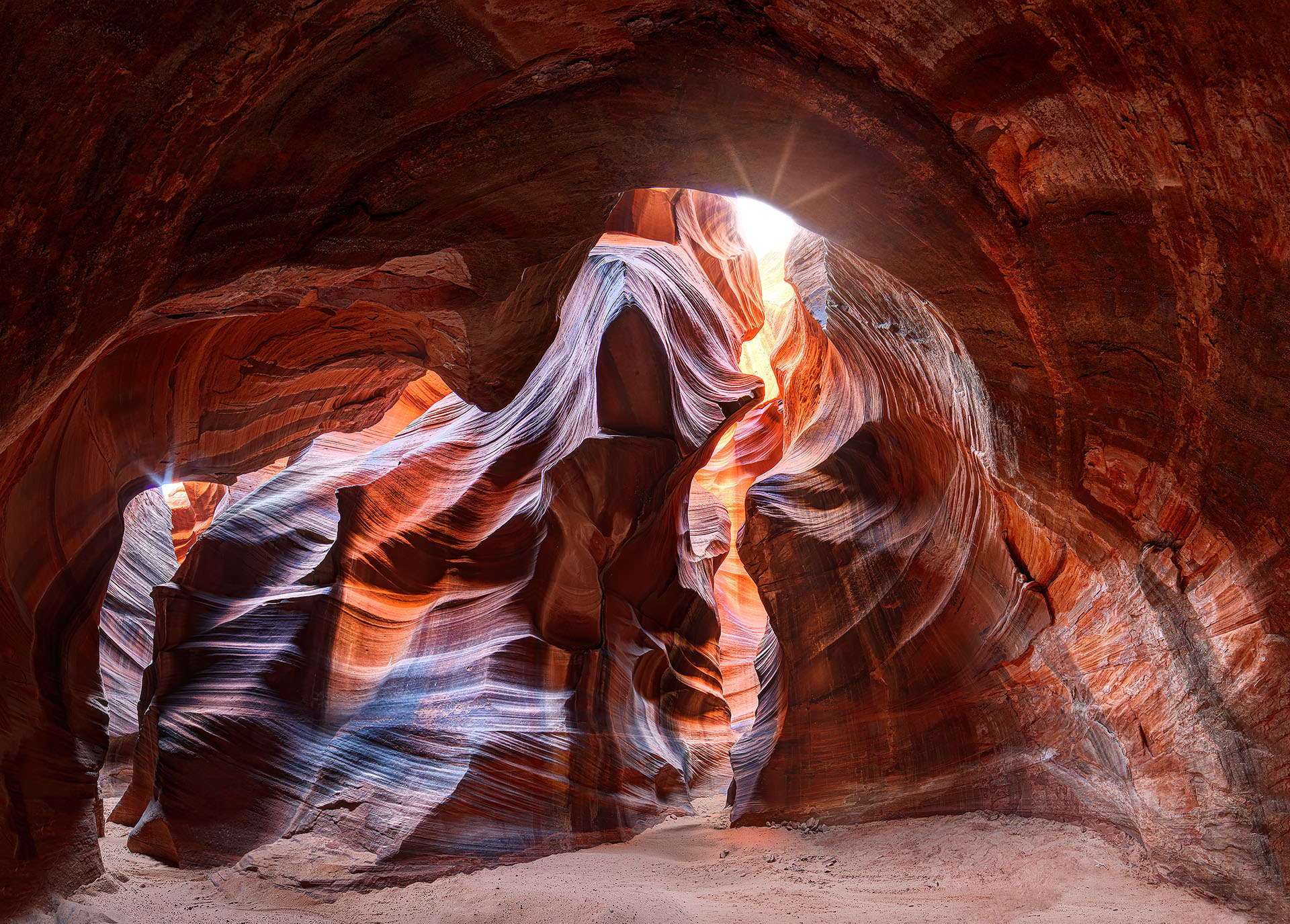
There are places you do not simply enter. You encounter them, as if crossing a threshold made not of stone and light, but of something far greater and unseen. Cardiac Canyon in Arizona is such a place.
Its walls rise high above, graceful and flowing, sculpted into soft curves yet carved from solid rock. Lines wind through the sandstone, written by time itself—layer upon layer, memory upon memory. This stone began as ancient dunes during the age of the dinosaurs, transformed over unimaginable spans of time by pressure, wind, and the ceaseless breath of the Earth. Yet it was not silence alone that shaped this cathedral-like place.
Water once moved through here. Rarely, but with an irresistible force capable of changing everything. When powerful summer thunderstorms release torrents of rain across the distant expanses of Arizona’s high desert, something awakens. Runoff gathers into sudden flash floods that surge through these narrow passages without warning. Carrying sand and gravel, the water sculpts, deepens, and refines the canyon. Between these events, persistent winds sweep sand through the winding corridors, polishing the stone. What appears gentle today is the result of moments of extraordinary energy—a partnership between patient time and raw natural power, between millennia and fleeting moments.
And then there is the light.
Before the midday sun reaches the canyon floor directly, something almost impossible to describe begins to unfold. Indirect, reflected light ignites the walls from within. It is a quiet transition, a breath held by the canyon itself. Iron oxides locked within the sandstone—a rich symphony of reds, golds, magentas, and deep violets—awaken in an extraordinary display of color. For a few precious moments, this palette intensifies into something almost unreal, as though the canyon itself dissolves into a celebration of light, form, and color. The sun has not yet arrived, but its presence is already announced. Delicate rays begin to trace the sculpted openings above—a subtle promise of the magic to come.
At the right moment, sunlight pours down into this vast chamber as if the sky itself had opened a narrow doorway. It reflects from wall to wall, becoming softer, warmer, almost tangible. For an instant, the canyon seems to breathe. And when the wind moves through the curved sandstone forms, the chamber begins to sing. Quietly at first, almost imperceptibly, then louder and more resonant—like distant water gathering strength before rushing into the canyon. It is a sound that feels like a memory of its own past, not gone but transformed into wind.
Although I stood completely alone within this chamber while creating this photograph, one is never truly alone here. This is profoundly sacred ground. Those who have not experienced it may find that difficult to believe, yet the presence of something greater is undeniable. Mountain lions move silently through the canyon’s winding passages like shadows crossing stone. Rattlesnakes depend upon the warmth of the rock for their movements. Tarantulas follow their own quiet rhythms, each one part of the greater tapestry of life.
And with that awareness, something changes.
Every step becomes more deliberate. Every glance more attentive. Not out of fear, but out of respect. One begins to understand that we are not separate from this place, but part of a larger whole in which everything has its place. The Navajo people, who have lived upon this land since time immemorial, speak of presence—of beings unseen yet deeply felt. To them, this is not merely landscape, but a relationship between people and the natural world.
Standing among these immense forms, another realization emerges—one that is difficult to put into words. This place was not made for us, nor does it belong to us. Yet we are allowed to be here with humility and care. Perhaps that is where its true power lies: a place that asks for nothing, yet changes everything.
The uniqueness of this photograph lies not only in the place itself, but also in the way it was created. What appears to be a single, effortless view is in reality the result of a patient, almost meditative photographic process. To capture the immense contrast between the glowing openings above and the deep shadows within the canyon, every frame was photographed using multiple carefully graduated exposures, ranging from bright to dark.
At the same time, the camera—securely mounted on a tripod—moved slowly through the chamber, frame by frame, with gentle overlap, gradually revealing the full panoramic scale of the space. From many individual moments, a single image emerged. Twenty-five photographs merged into one composition, preserving not only the chamber itself, but also its depth, texture, and hidden radiance.
Perhaps it is this devotion to a fleeting moment that allows something otherwise intangible to become visible—and gives this image a uniqueness that can never be repeated.