
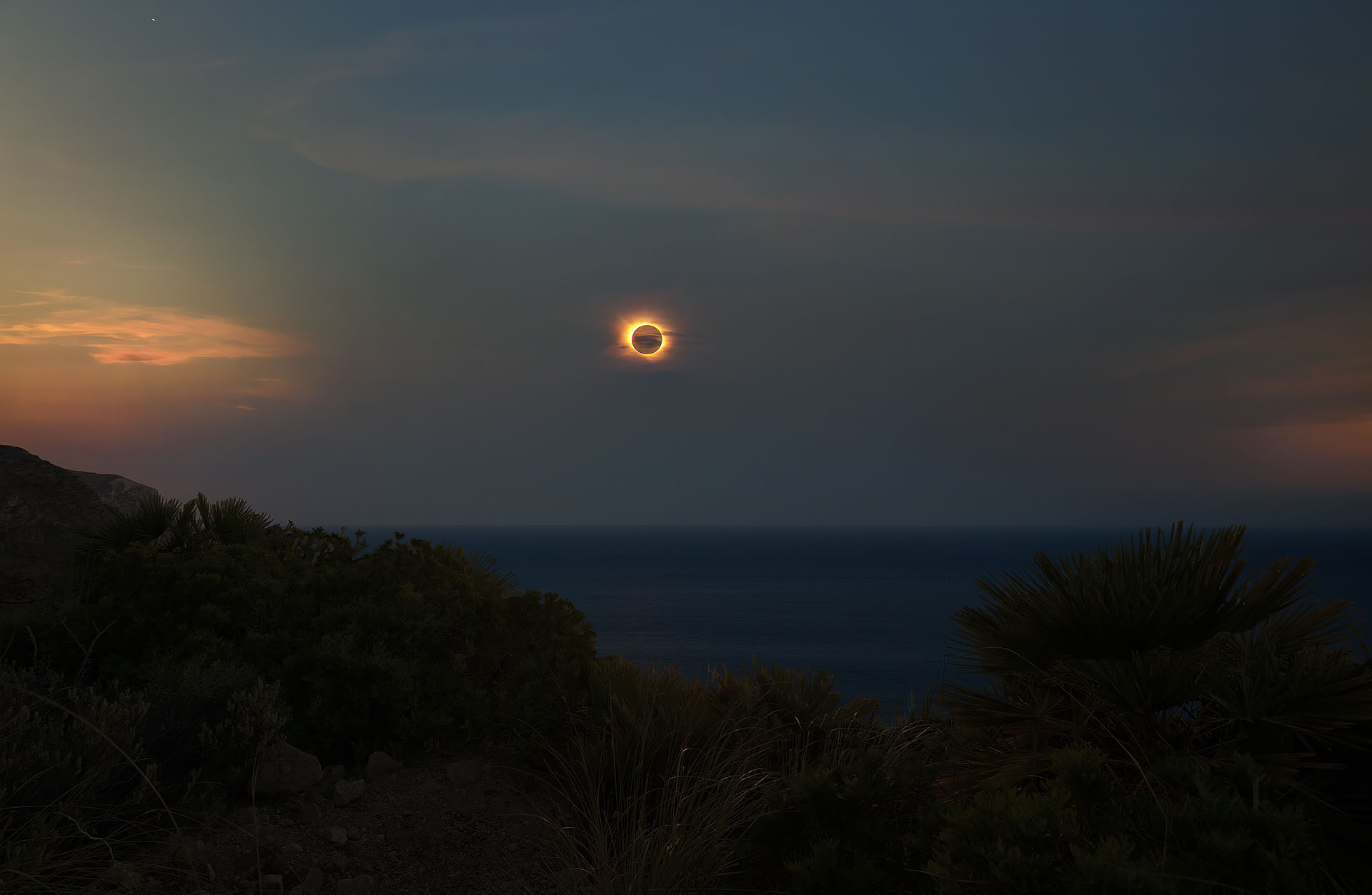
Until shortly before the total solar eclipse on 12 August 2026, Mallorca basked in brilliant sunshine. The sky was cloudless and deep blue, and a sweltering heat of 37 degrees Celsius (99 degrees Fahrenheit) hung over the island. Facing northwest across the Mediterranean, young Mediterranean dwarf palms (Chamaerops humilis) rose in the foreground, their long, pointed leaves forming tiny crowns. To the left, the steep coastal cliffs of the Tramuntana Mountains marked the edge of the island.
Yet, precisely in the northwest, where the low Sun would slip into eclipse just a short time later, at 8:31 p.m., high, veil-like clouds began to gather. They belonged to a massive thundercloud that had formed over the Spanish mainland. Our concern was all too real: would this unique solar eclipse fall victim to the only cloud in the sky that day? Just a few miles to the north, that was exactly what happened. But here, at our vantage point, the cloud became the defining element in a scene more beautiful than we could ever have imagined. At the crucial moment, it began to thin, becoming translucent as a perfectly circular opening formed around the corona.
As the Moon covered 95 percent of the Sun, the evening light turned ashen and began to fade almost completely. The colors of sunset, with clouds still glowing in the sunlight, remained on either side, while the sky around the eclipse took on an eerily dark violet-blue-gray hue. As the Moon’s shadow raced across Earth at 300 kilometers per minute (186 miles per minute), the hot Mallorcan summer evening gave way to a deep, otherworldly twilight. Within seconds, Venus appeared in the sky, shining brilliantly.
Through the delicate veil of cloud, the intricate structures of the solar corona, with temperatures reaching three million degrees Celsius (5.4 million degrees Fahrenheit), came into view. The corona’s light even shimmered through the clouds in front of the Moon, so that the lunar disk did not appear as the completely black silhouette we usually see during totality.
On either side of this extraordinary scene, the evening sky retained its warm pastel hues. Directly beneath the black Sun, however, an unfamiliar blue-gray settled over the sea and landscape, while a delicate glimmer of reflected light appeared on the water.
For 96 seconds, day and night occupied the sky at the same time. To witness this spectacle, the Sun had to be extraordinarily low, just two degrees above the horizon. It was a rare opportunity to experience the black Sun together with the Mediterranean, the Tramuntana Mountains, and Mallorca’s landscape. Silent. Powerful. Epic. A monumental dialogue between Sun, Moon, and Earth, leaving an impression that will never fade.
A star of immense proportions is completely concealed by the small Moon. This seemingly impossible geometric coincidence is precisely what makes a total solar eclipse possible: the Moon moves in front of the Sun, leaving only its corona visible for a fleeting moment. The Sun is 400 times larger than the Moon, but it is also 400 times farther from Earth. As a result, the two celestial bodies appear almost exactly the same size, allowing the Moon to completely obscure the Sun’s photosphere. In a matter of seconds, the sunlight that has traveled for eight minutes from the Sun to Earth gives way to the sight of a black Sun.
A total solar eclipse is no ordinary astronomical event. It is a threshold experience. For 96 seconds, our sense of time and space, light and landscape shifts. The familiar sky becomes strange. For one brief moment, we feel with overwhelming clarity how deeply everything is connected: Sun, Moon, Earth, atmosphere, sea, landscape, and the human being standing amid it all.
My cordial thanks for the perfect opening in the clouds, in exactly the right place, go to my inner circle: Tala Mohajeri, Gabi Retzkowski, Annika Beck, Tanja Mihailovic, and Christina Heinemann. My thanks also go to the on-site photography team, Dr. Frank Paul and Alex Meier, as well as Laura Janina and Alan Majsik, who gave us invaluable support and carried the many tripods across the rugged terrain.