
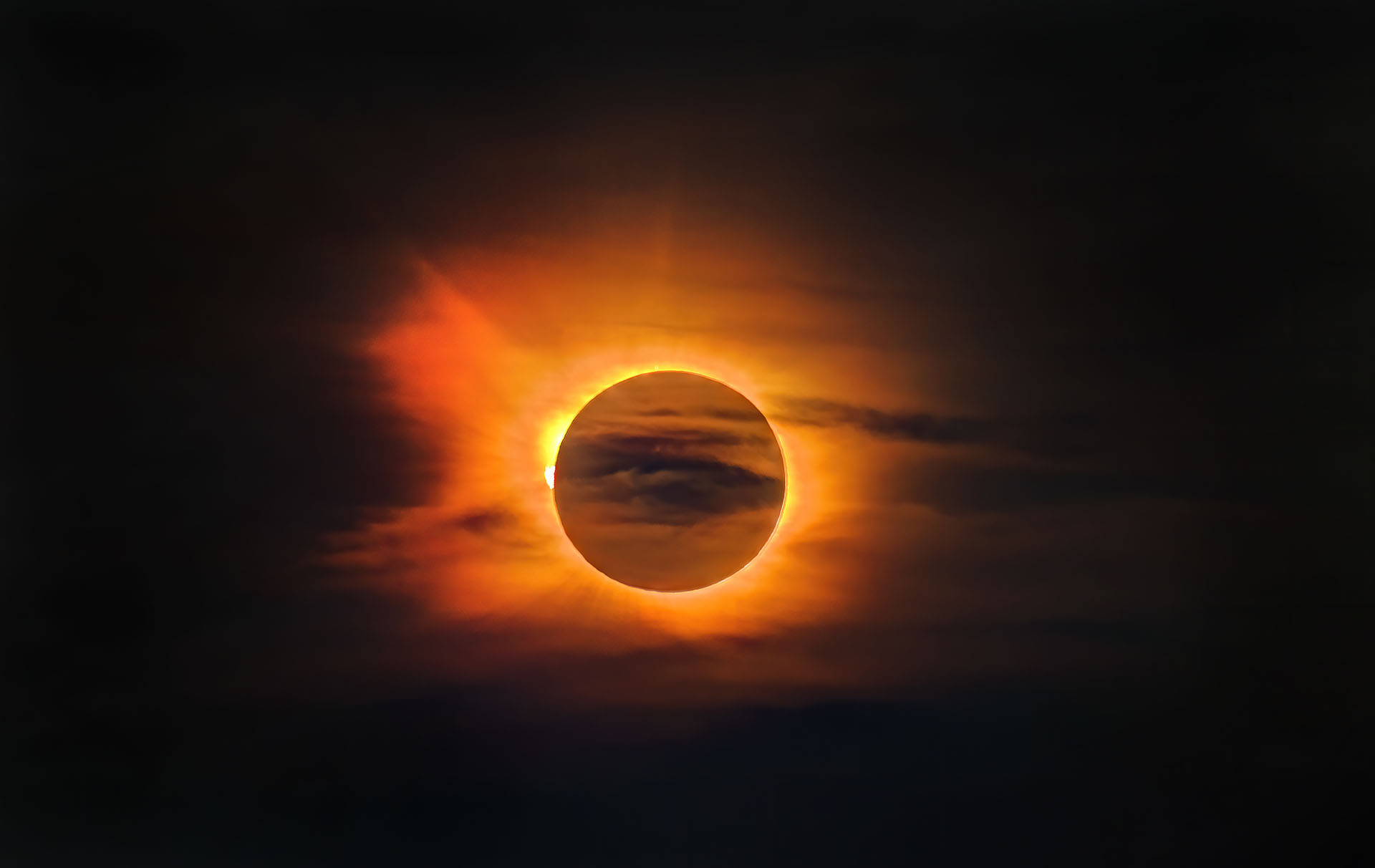
During the total solar eclipse over Mallorca on 12 August 2026, the Sun hung low above the Mediterranean at 8:31 p.m. As the Moon completely obscured the blindingly bright Sun, it revealed something normally hidden from view: the solar corona. Because the Sun was so close to the horizon, its light traveled an exceptionally long path through Earth’s atmosphere. Instead of the familiar white corona seen during eclipses when the Sun is high overhead, it glowed in the warm golden hues of the approaching sunset. Translucent veils of yellow-red cloud merged with the corona’s delicate, hairlike structures and long streamers, creating a singular spectacle that seemed to dissolve into the black void of the darkened sky.
Illuminated clouds lent structure to the Moon’s normally pitch-black silhouette, transforming it into a vast eye in a burning sky. The clouds caught the warm yellow and red tones of the day’s last light, forming a luminous frame around the lunar disk and the solar corona. Here, two worlds met: clouds in Earth’s atmosphere and the plasma envelope of our star, 150 million kilometers (93 million miles) away and reaching temperatures of up to three million degrees Celsius (5.4 million degrees Fahrenheit). The corona is the Sun’s outermost atmosphere. Within this intensely hot plasma, matter exists in a radically different state. Atoms in the solar atmosphere lose their electrons, leaving behind free electrons and positively charged ions. The shape of the corona is governed largely by the Sun’s magnetic field. Along these invisible magnetic structures, the plasma forms immense arches, filaments, and streamers. What appear to our eyes as delicate tufts of hair or threads of light are structures of extraordinary dimensions. From this magnetically shaped atmosphere flows the solar wind, a continuous stream of charged particles that extends far into interplanetary space. When it reaches Earth, it interacts with our planet’s magnetosphere, giving rise to the spectacular auroras seen in the polar regions.
We can observe these fascinating structures only during a total solar eclipse because of the enormous difference in brightness between the corona and the Sun’s photosphere, its visible surface. The photosphere is millions of times brighter than the corona, completely overwhelming its delicate glow. Only when the Moon precisely obscures the photosphere does the corona become visible for a brief moment. The Sun’s dazzling light recedes, revealing its otherwise hidden outer atmospheric layers.
The Moon’s shadow, which made this moment possible, had traveled a long path across Earth that day, from Greenland through Iceland and along the northern Spanish coast to Mallorca. Racing across the surface at an astonishing 300 kilometers per minute (186 miles per minute), equivalent to approximately 17,500 kilometers per hour (10,900 miles per hour), this circular shadow briefly projected the darkened patch of the eclipse onto Earth. During totality over Mallorca, the Sun reached one of the lowest elevations at which a total solar eclipse has ever been observed from an accessible location. This exceptionally low angle allowed the colors of sunset to merge with the intricate structures of the corona.
The eclipse thus becomes far more than a spectacular celestial display. For a brief moment, it opens a window onto the connection between the universe and our world. Looking skyward reminds us that Earth has never existed in isolation. Our planet is embedded in the dynamic life of a star, sustained by the life-giving energy and warmth of our Sun, which have made it possible for Earth’s intricate web of life to unfold.
My cordial thanks for finding the perfect opening in the clouds, in exactly the right place, go to my inner circle: Tala Mohajeri, Gabi Retzkowski, Annika Beck, Tanja Mihailovic, and Christina Heinemann. Without the shared pool of data from our on-site photography team, consisting of Dr. Frank Paul, Alex Meier, and myself, this richly varied photographic documentation of the eclipse would not have been possible. For that, I will be forever grateful to you all. My sincere thanks also go to Laura Janina and Alan Majsik for their invaluable moral support in the field and for carrying the many tripods across the rugged terrain.