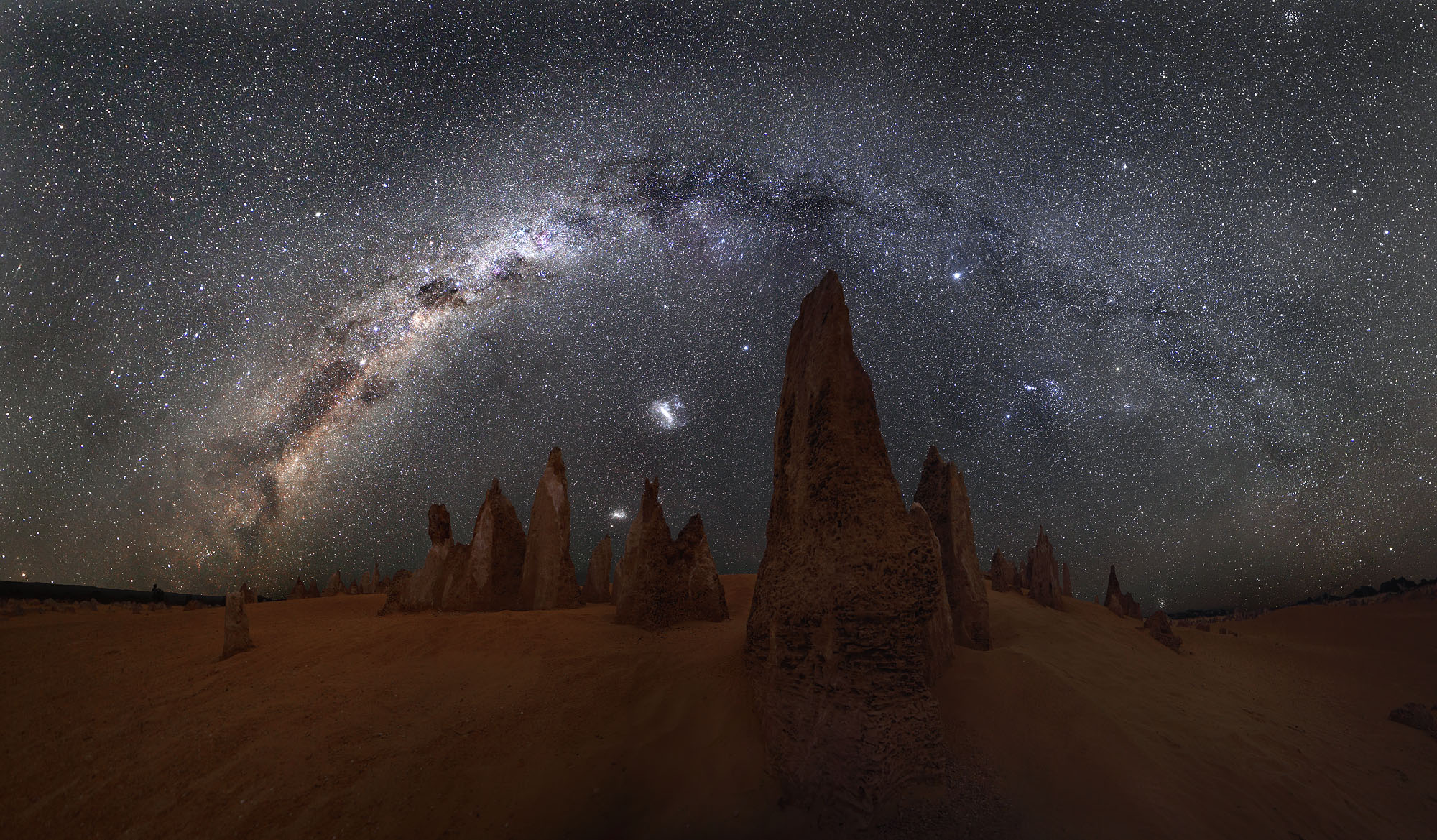
The Pinnacles of Nambung in Western Australia tower beneath the majestic arc of the bright Southern Milky Way and the Magellanic Clouds, two irregular dwarf galaxies orbiting the Milky Way. It is not difficult to imagine that this image could well have been taken on a distant extrasolar planet.
These pinnacles are rock towers up to 5 m (16 ft) tall that mainly consist of cemented, 10,000-year-old dune sand. Most of this sand consists of tiny remains of carbonate-skeleton organisms that lived in the warm ocean and were transported inland by prevailing strong winds. However, the dunes solidified only in places where trees were growing on top of them. Rainwater percolated down to the tree roots and cemented the sand. Over time, the tree roots rotted away while the hardened dune sand was preserved. Later, the wind removed the unconsolidated dune sand, leaving behind the pinnacles we see today.
At this remote place, with no anthropogenic light sources around, the austral summer Milky Way twinkles in all its pristine glory. The brightest parts of the Milky Way are in the constellation Scorpius, just above the left horizon, intersected by a band of dark interstellar dust clouds blocking the starlight. The constellation Centaurus is home to the bright star Alpha Centauri, also known as Toliman, which belongs to our closest neighboring stellar system at a distance of 4 light-years. The famous Southern Cross is located to the upper right of the dark stellar dust cloud known as the Coalsack. Both Magellanic Clouds are just above the pinnacles, two irregular dwarf galaxies orbiting the Milky Way at a distance of about 160,000 light-years. The northern part of the Milky Way is dominated by the super-bright star Sirius, followed by the well-known constellation Orion and Taurus with its prominent Pleiades star cluster directly above the horizon.
A night out beneath the bright vault of heaven, surrounded by these towering pinnacles, is a truly unique experience.