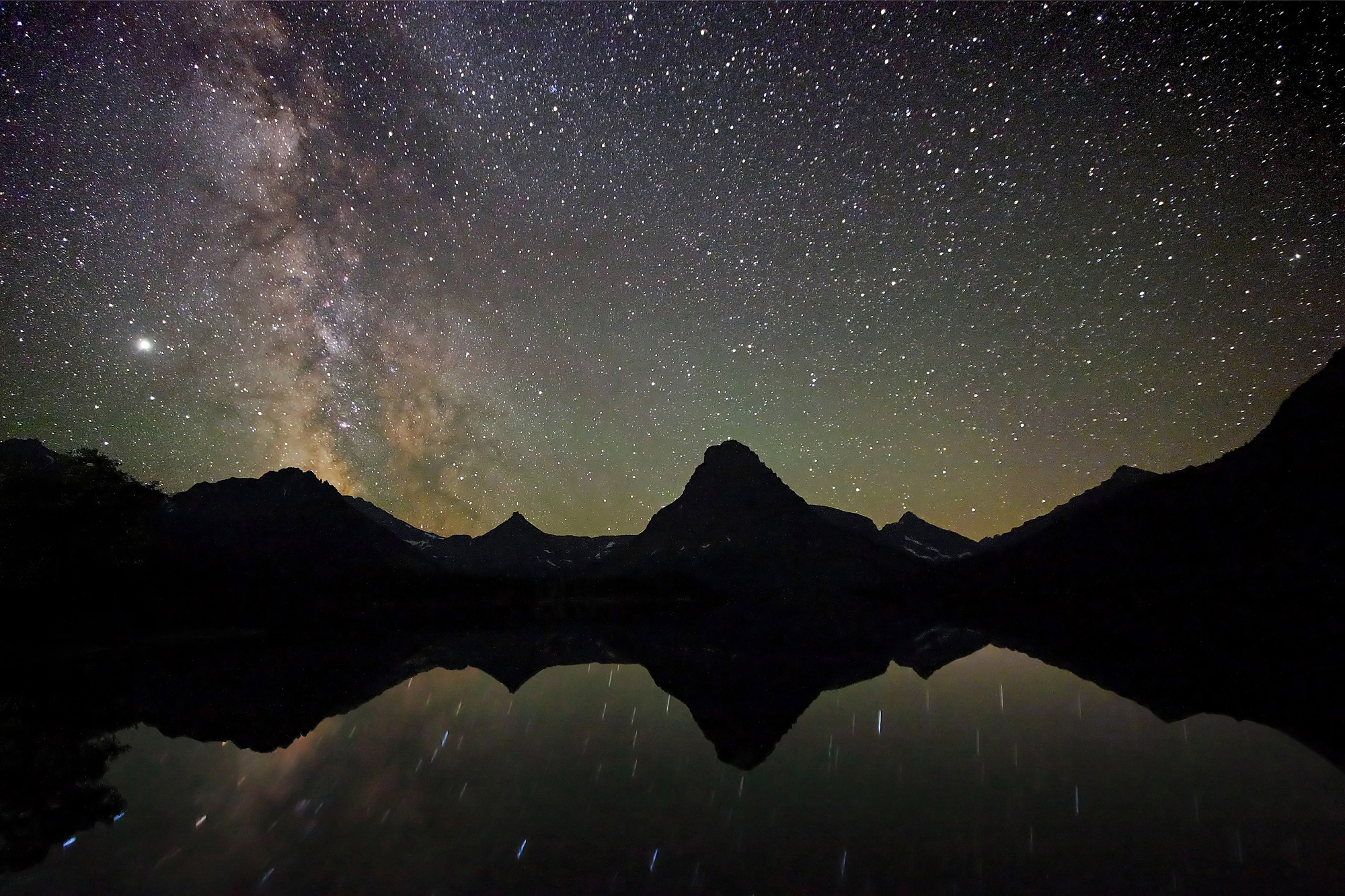
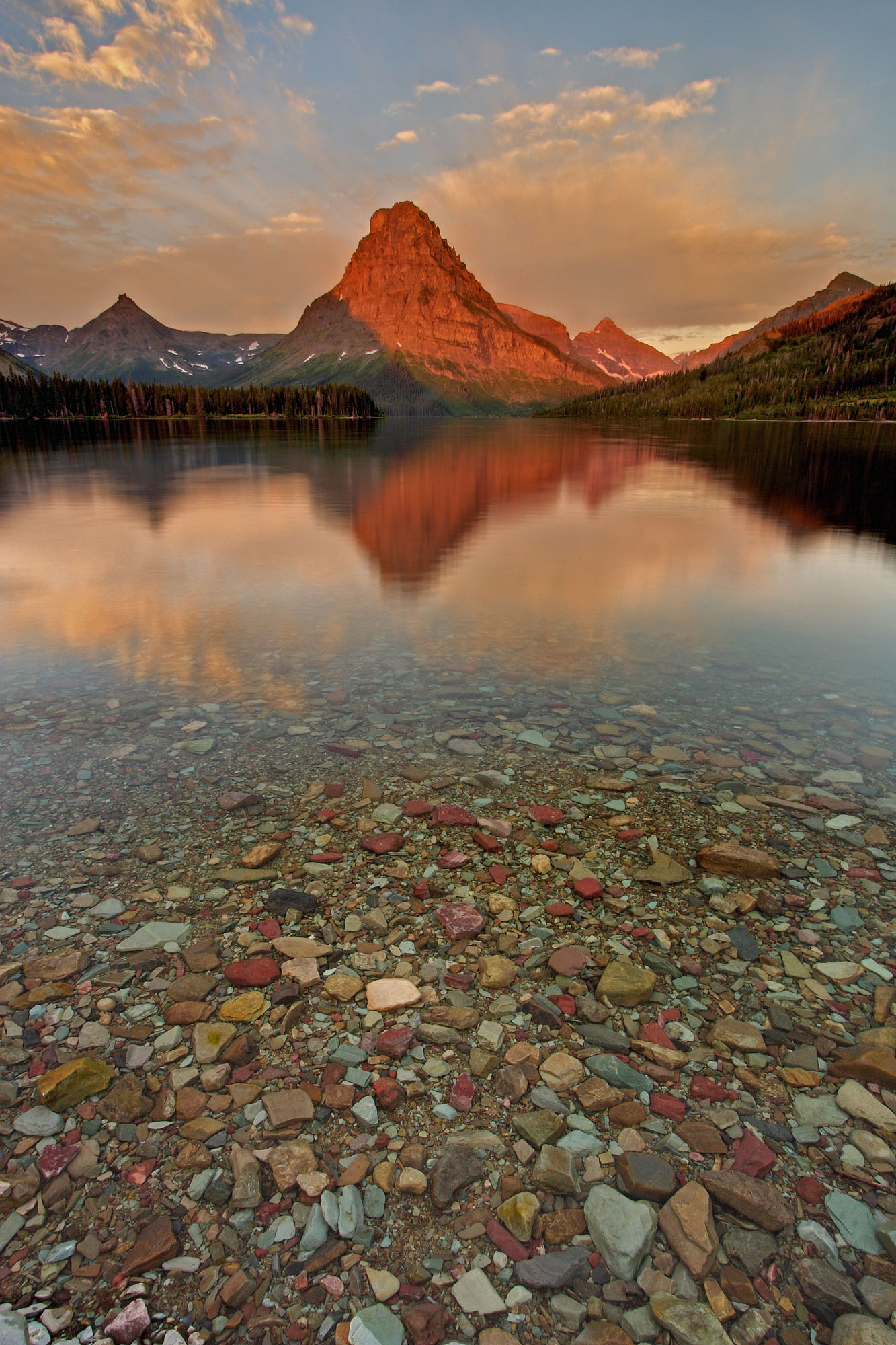
During sunrise, Sinopah Mountain is perfectly reflected in Two Medicine Lake in Waterton Glacier. The colorful pebbles in the foreground are an astonishing 1,500 million years old and contain evidence of some of the earliest life forms on Earth: reef-forming stromatolites.
At that time, the ancient North American continent was a barren landmass surrounded by shallow seas, streams, and mudflats. Cyanobacteria built the first reefs on Earth, which were fossilized as stromatolites. Wave action formed ripple marks, and even tiny impact craters made by raindrops falling into the mud have been preserved in these rocks. They provide a snapshot of a world 1,000 million years before the first animals appeared.
Here, the continent repeatedly began to split apart along a north-south-trending trough, but each attempt failed. This formed a rift valley in which sediments from the surrounding land accumulated to a total thickness of 13 miles (21 km), creating one of the largest sedimentary deposits on Earth, known as the Belt rocks. Around 750 million years ago, the western part of ancient North America drifted away, forming its own continent, today known as Antarctica. The Northern Rockies we know today consist largely of these Belt rock sediments. Their uplift began 80 million years ago. The mountains we see today are reflected in a lake that formed within a glacial trough after the last Ice Age.