
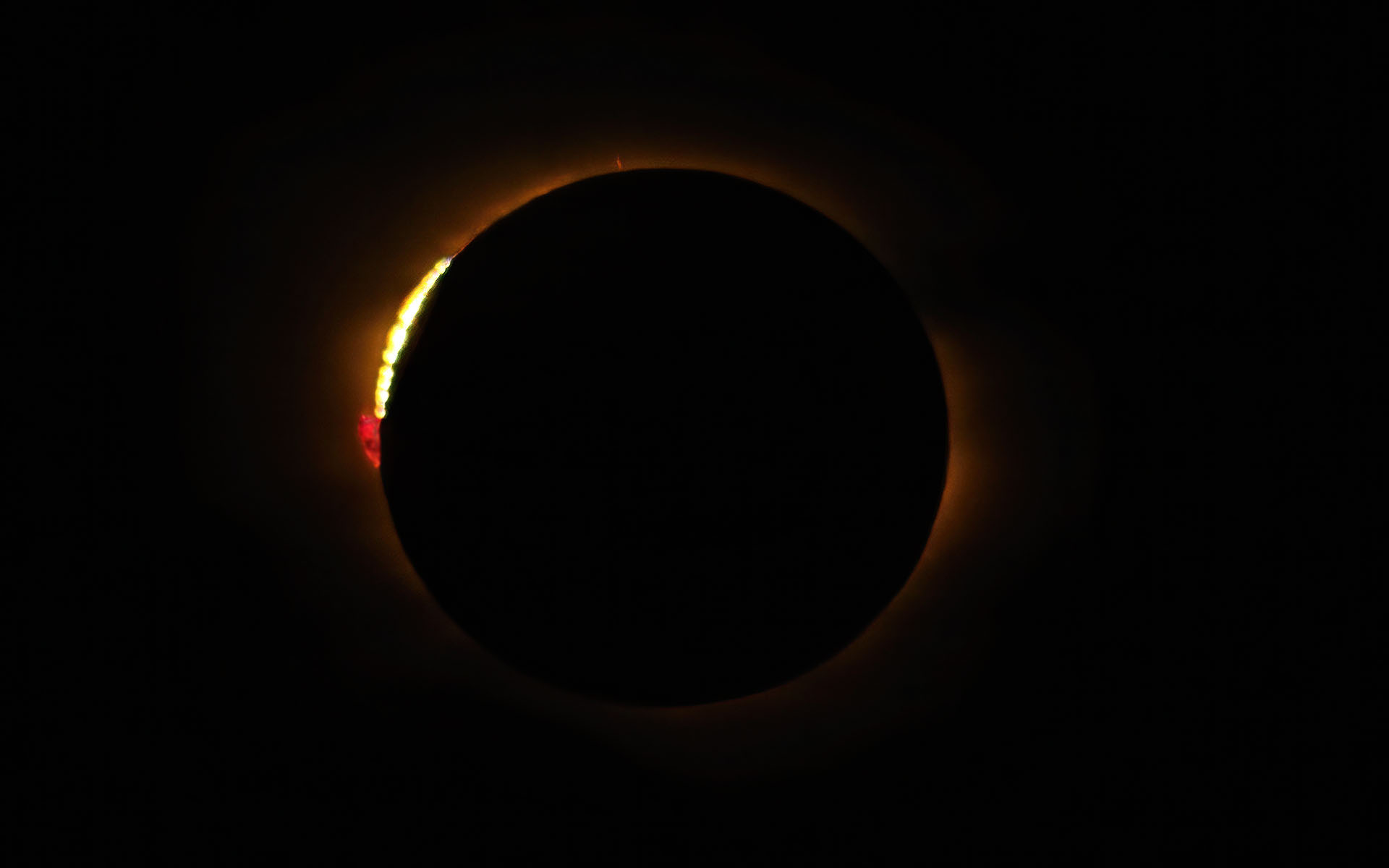
On 12 August 2026, during the total solar eclipse over Mallorca, the sky darkened in a matter of moments. The Sun stood barely two degrees above the horizon as the Moon moved toward completely covering it. This is a fleeting glimpse at the threshold between daylight and totality, captured in those vanishing fractions of a second when the last direct sunlight disappears and the black Sun emerges against an already darkened sky. There is no colorful sky, no landscape, no sea in this view. Only darkness and a slender, fiery line. The seemingly impossible spectacle of a black Sun.
Enormous solar prominences blaze along the upper and left edges. These structures consist of relatively cool plasma held in vast arcs above the Sun’s surface by its magnetic field. Some of these arcs are larger than Earth and can persist for days or even weeks. At the moment of the eclipse, they appear like flickering flames along the black edge of the Moon, hinting at the immense forces at work within our star.
Then appear Baily’s beads, the fascinating string of pearls along the Moon’s edge. They emerge in the final moments before totality, when sunlight is no longer visible directly across the entire lunar limb but shines through individual deep valleys and irregularities in the Moon’s rugged terrain. Each flash of light offers a tiny glimpse of the Sun’s photosphere. For fractions of a second, the edge of the black lunar disk transforms into a luminous string of pearls.
At the same time, the corona is already visible. Although the photosphere has not yet disappeared completely, its delicate halo of light extends almost all the way around the black lunar disk. The corona reaches far beyond the Sun’s visible surface. As soon as the Moon partially screens the photosphere’s dazzling light, the corona’s outer structures, millions of times fainter, begin to emerge. What appears here as a delicate reddish rim is the outer atmosphere of our star, heated to millions of degrees. Under normal conditions, the corona appears a soft white. But with the Sun so low above the horizon, its light travels a long path through Earth’s atmosphere, altering its apparent color and lending it warm shades of orange and red. This unusual coloration gives the black Sun an almost magical atmosphere.
The fact that the Moon, as seen from Earth, appears almost exactly the same size as the Sun is an extraordinary geometric coincidence. The Sun is about 400 times larger than the Moon, but it is also about 400 times farther from Earth. This is why the two celestial bodies appear nearly identical in size, allowing the Moon to completely obscure the photosphere while leaving the corona visible.
Yet this cosmic coincidence is not destined to last on geological timescales. Through tidal interactions between Earth and the Moon, our satellite is moving away from our planet by about 3.8 centimeters (1.5 inches) each year. Its apparent size in the sky is gradually shrinking. We therefore live in a remarkable cosmic age: a time when the Sun and Moon appear almost exactly the same size from Earth, making total solar eclipses possible.
Dinosaurs, too, witnessed total solar eclipses. Back then, however, the Moon was closer to Earth and appeared several percent larger in the sky than it does today. Under comparable conditions, it could therefore cover the Sun for longer. In the distant future, the Moon will appear too small in the sky to obscure the Sun completely. Only annular eclipses, in which a bright ring of sunlight remains around the Moon, will then be visible. Eventually, even these will no longer be observable from Earth.
In this way, the black Sun above Mallorca becomes a journey through cosmic time. We are witnessing a moment that is not merely fleeting and ephemeral, but part of an immense story unfolding between Earth, Moon, and Sun. Baily’s beads flash into view, prominences blaze, the corona begins to shine, and for one brief moment, time seems to stand still between light and darkness.
Dazzlingly bright, yet invisible. A cosmic spectacle we can witness only because, in the long history of our home planet, we happen to be alive at precisely the right moment.
My cordial thanks for finding the perfect opening in the clouds, in exactly the right place, go to my inner circle: Tala Mohajeri, Gabi Retzkowski, Annika Beck, Tanja Mihailovic, and Christina Heinemann. Without the shared pool of data from our on-site photography team, consisting of Dr. Frank Paul, Alex Meier, and myself, this richly varied photographic documentation of the eclipse would not have been possible. For that, I will be forever grateful to you all. My sincere thanks also go to Laura Janina and Alan Majsik for their invaluable moral support in the field and for carrying the many tripods across the rugged terrain.