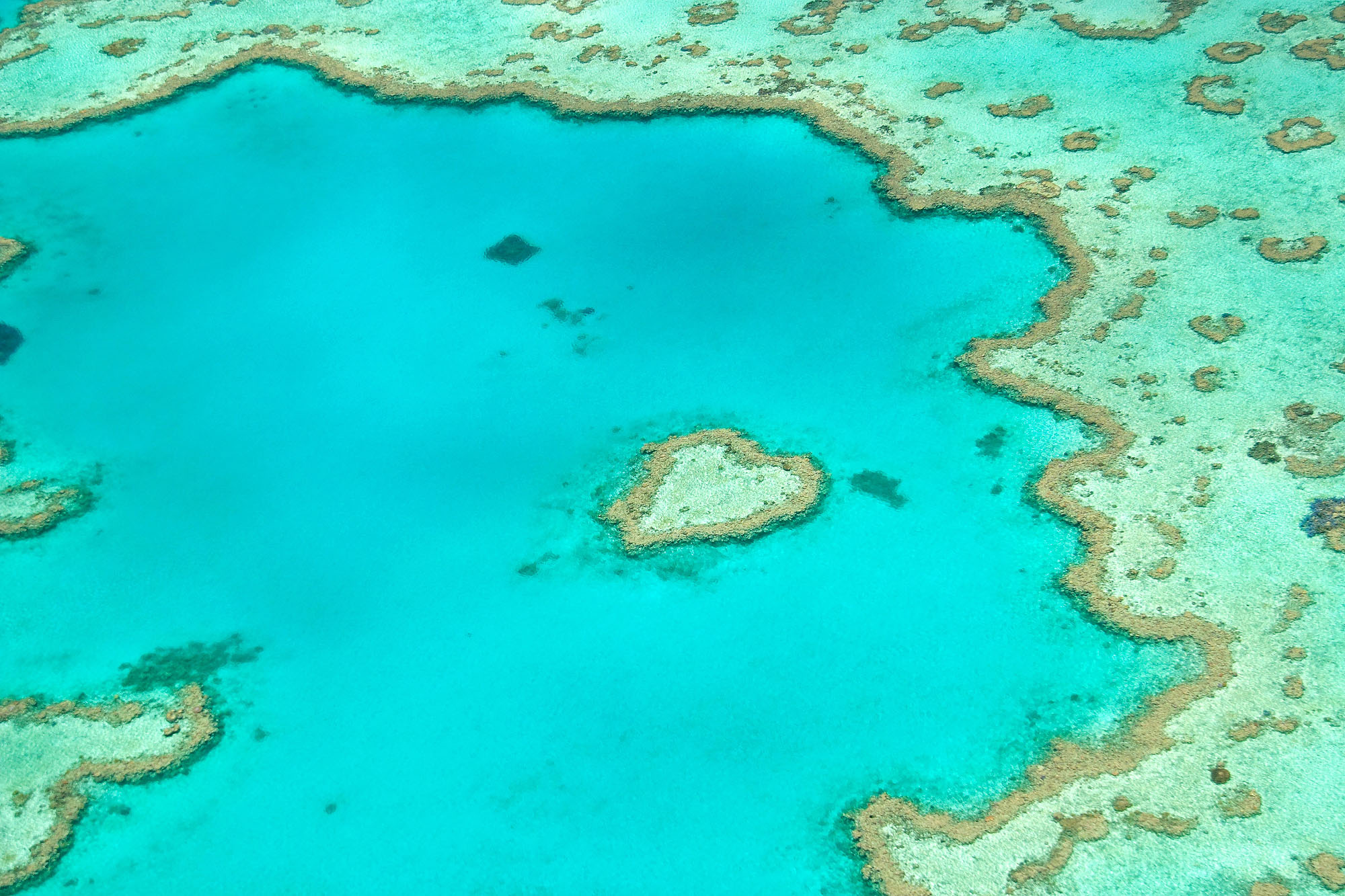
Hardy Reef in the Great Barrier Reef is a heart-shaped mini-atoll located about 100 km (60 mi) off the coast of Queensland and the Whitsunday Islands in northeastern Australia. The Great Barrier Reef stretches along the Australian continental shelf in the Coral Sea and is the largest living structure on Earth, extending for 2000 km (1600 mi) and even being visible from space. It comprises more than 2500 individual reefs and 540 islands, forming an offshore barrier.
The combination of fringing reefs that form along the coast and around offshore islands and shelf reefs that grow offshore creates beautiful turquoise-colored lagoons. The lagoons are filled with soft sediment consisting mainly of the remains of living organisms. The reef tops lie close to sea level, while their bases can reach depths of 40 to 100 m (130–330 ft). Seaward of the lagoon, the reef flat and the windward edge mark the transition zone where the continental shelf ends and the water depth increases. Visually, the ocean color changes from turquoise in the lagoons and brownish tones on the reef flat to the deep blue of the open ocean. Often, the windward edge of the reef is additionally marked by the white water of breaking waves.
Corals grow most prolifically in shallow, warm and light-flooded saltwater, without turbidity caused by coastal sediments or freshwater discharge from rivers. Throughout the year, the sea surface temperature of the Great Barrier Reef varies between 24°C (75°F) and 30°C (86°F), which is ideal for coral growth. The growth of the reef is a dynamic balance between the coral organisms that form and cement the hard substrate and the erosive forces of organisms that feed on the reef, together with the destructive wave action generated by high wind speeds. Cyclones are a particular threat to reefs. Their hurricane-force winds generate destructive waves that can bury corals beneath sand and debris. Over the last thousands of years, the balance has been positive, and the Great Barrier Reef has grown at an average rate of 5–8 mm (0.2–0.3 in) per year.
Flying over Hardy Reef is a truly unique experience. The varying colors and shapes of the coral reefs have fascinated me deeply and helped me to better understand and appreciate this unique environment and the fragility of this ecosystem.