
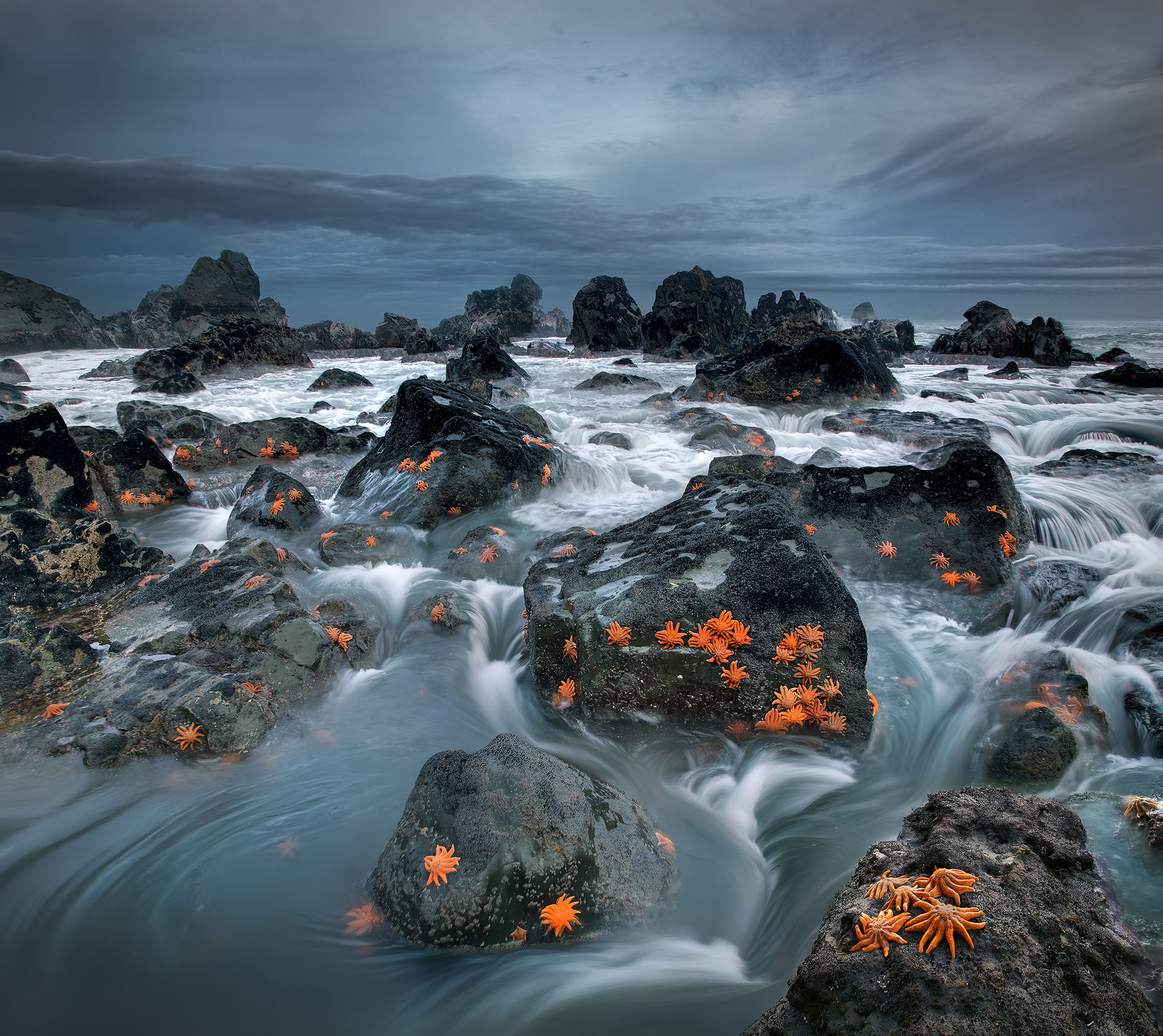
The surf of the Tasman Sea crashes with relentless power against the rock platforms of Motukiekie Beach on the west coast of New Zealand’s South Island. Water rushes through the intricate maze of rocks, swirling around dark sandstone ridges and flooding the shoreline in the endless rhythm of the tides. The cloud-covered sky announces an approaching storm, while the ocean has been shaping and reshaping this landscape for millions of years. Yet the true fascination of this place does not lie in its spectacular rock formations or its dramatic waves. It reveals itself only when we look more closely.
At low tide, the dark gray and black rocks reveal a remarkable hidden world: the glowing orange reef sea stars (Stichaster australis). Thousands of them inhabit this intertidal zone, each individual searching for food while remaining part of something far greater. Among mussel beds, algae, barnacles, and countless other organisms that coat the rocks with a living tapestry, they form an intricate network of life. Every species plays its own role within this web. None exists alone.
The ancestors of these sea stars belong to one of the oldest animal groups on Earth. For more than 500 million years, representatives of the echinoderms have inhabited the oceans of our planet. During this almost unimaginable span of time, continents have merged and drifted apart again, towering mountain ranges have risen and been eroded away, entire ocean basins have opened and closed, and five major mass extinctions have repeatedly challenged life itself. Yet the echinoderms endured. Not because they were the strongest organisms or because they followed some imagined path of evolutionary superiority. Their survival reflects one of the great abilities of life itself: the capacity to change, to find new pathways, and to continually adapt within Earth’s ever-changing networks. Evolution does not reward the strongest. It preserves those lineages that discover new possibilities in a changing world and maintain their place within the web of life. And, as in all great stories of evolution, chance has played an important role as well.
Motukiekie Beach reveals what truly allows life to endure over time. It is not the dominance of a single species, but the diversity of the living web and the countless relationships that connect its members. Only through the interaction of innumerable species does an ecosystem gain stability. From this diversity emerges the remarkable phenomenon of emergence: the ability of living systems to create qualities that are greater than the sum of their individual parts. At the same time, every additional connection strengthens resilience – the ability to withstand disturbances, overcome crises, and renew itself again and again.
This is where the wisdom of life can be found. Nature does not seek maximum growth and the dominance of a single species, but rather a dynamic balance that allows change and enables adaptation. That is why ecosystems such as this have endured for immense periods of time and have remained successful over evolutionary history. They are not built on waste, but on interconnected cycles in which materials are continually passed on, transformed, and reused. They do not exist in isolation, but in profound interdependence. Every living being is part of a greater whole upon which all ultimately depend.
Today, humanity possesses the power to alter this delicate network of life on a scale unmatched by any species before us. With every lost habitat and every vanished species, the connections that have made life on Earth resilient for billions of years grow weaker. What we lose are not merely individual species. We lose the stability of the whole – and, step by step, the foundation of our own existence.
The Earth preserves its past in its rocks, in the traces of ancient oceans, wandering continents, and worlds long gone. Yet its future lies in its networks of life: in the invisible connections among all organisms that together possess the ability to endure change and create new life.
Therefore, protecting the climate, nature, and the ecosystems of this planet is ultimately an act of self-preservation. Motukiekie Beach is far more than a spectacular coastal landscape. It is a place where we can learn how successful life truly works. A place where the ocean, the rocks, and countless glowing sea stars have been telling the same story for hundreds of millions of years:
The greatest strength of life does not lie in the individual, but in the network that connects everything.