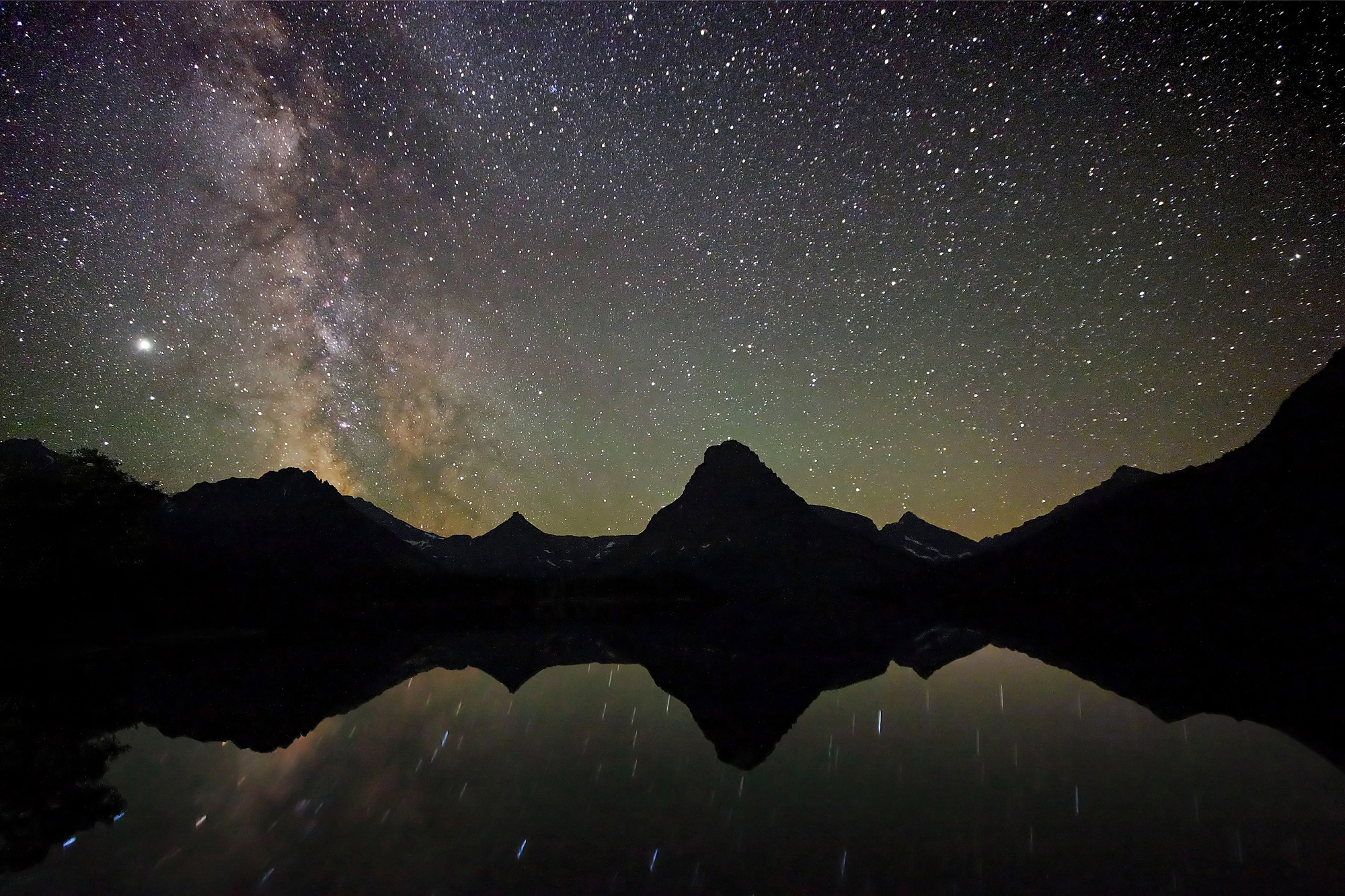
The Milky Way rises with Jupiter over Sinopah Mountain in Waterton Glacier and is reflected in Two Medicine Lake.
The starry sky at new moon sparkles like diamonds in total darkness, revealing a detailed view of our galaxy’s central structure, with its dense star fields and light-absorbing nebular dust. The Milky Way’s galactic center, with its presumed black hole, is located just above the horizon, deeply hidden by dark clouds of interstellar dust. Thus, our view of the Milky Way in the constellation Sagittarius has a bifurcated appearance. The small but bright reddish object above is the Lagoon Nebula, M8, a star-forming region at a distance of 5,200 light-years. The brightest object to the left of the Milky Way is Jupiter. The star trails remain visible in the lake due to the mirroring effect of tracking in the opposite direction.
A night out in the blackness of the new moon is an awe-inspiring experience. The grandeur of the Milky Way, the sublimity of the landscape, the chilly temperatures, and the presence of wildlife are intoxicating. Deep feelings of humility mingle with euphoria and fear, captivating the senses.