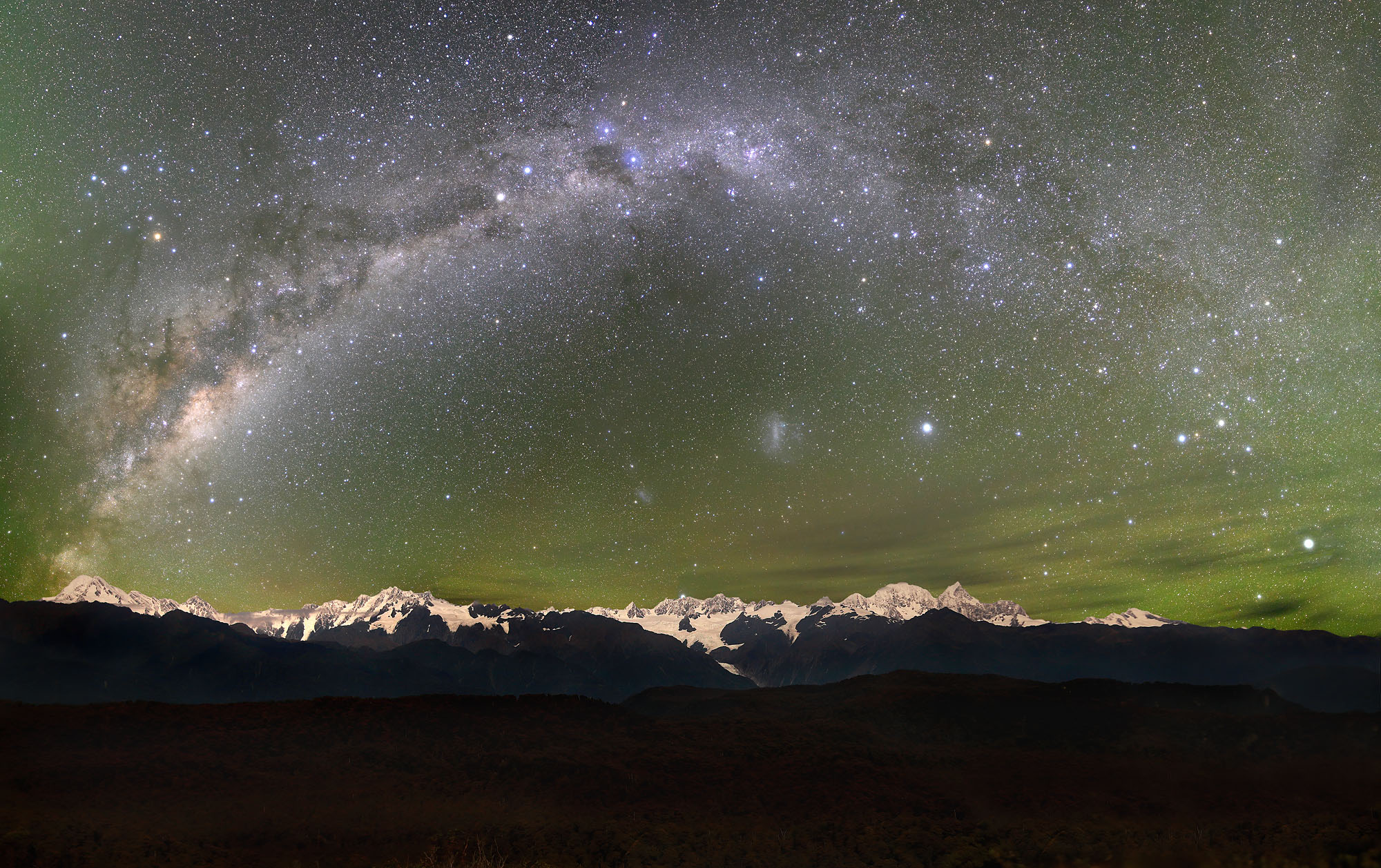
The ethereal glow of green southern lights, the Aurora Australis, envelops the arc of the Milky Way over the New Zealand Alps in an enchanting light. Thin cirrus clouds contrast darkly against the glowing night sky, while the snow-covered peaks of the Southern Alps, including Mt. Cook and Mt. Tasman, are illuminated by the first light of the rising crescent moon.
Faint and widespread green southern lights originate from electrically charged particles flung out by the Sun, colliding with oxygen atoms in the upper Earth’s atmosphere at an altitude of about 100 km (62 miles). The oxygen atoms absorb and immediately re-emit the energy of these particles. The release of this energy produces photons at the wavelength of green light, creating the ethereal glow.
The arc of the Milky Way spans the southern celestial hemisphere and stretches across the entire main ridge of the north-south-aligned Southern Alps, reaching all the way to the zenith. The brightly sparkling band of millions of stars in the Milky Way is interspersed with interstellar dust clouds that contrast darkly with the bright starry sky. These clouds block the light of the stars behind them and therefore appear visually as star-free gaps in the night sky.
At the northern (left) horizon, the Sagittarius constellation with the galactic center and the Scorpio constellation with its bright yellow main star Antares are most prominent. At the zenith, the famous Southern Cross sparkles and strongly contrasts with its neighboring interstellar dust cloud, called the Coal Sack. At the southern (right) horizon, the constellation Canis Major, the Great Dog, dominates, with Sirius, the Dog Star, being the brightest star in the night sky. Below the arc of the Milky Way and well above the highest peaks of the Southern Alps are the two neighboring galaxies known as the Magellanic Clouds, as well as the extremely bright star Canopus in the constellation Carina, the keel of the ship.
Capturing this nighttime panorama of the Southern Alps with the Aurora Australis and the Milky Way arc was a long-cherished dream coming true. At the same time, it marked my departure into a new era of ultra-high-resolution astronomical panoramic photography with virtually no significant image noise. The star-tracking system allows point-like stars to be photographed with minute-long exposure times, which would otherwise turn them into star trails after about 25 seconds due to the Earth’s rotation.
To capture this three-dimensional panorama, the scene covers 200° horizontally and 110° vertically. This required 20 individual 14 mm exposures, ten of them being star-field images taken with star tracking at six minutes each, and ten equally long exposures of the Alpine landscape shortly after moonrise. Thus, capturing this 106-megapixel photograph, including the calibration and alignment of the astronomical tracking system, took seven hours.