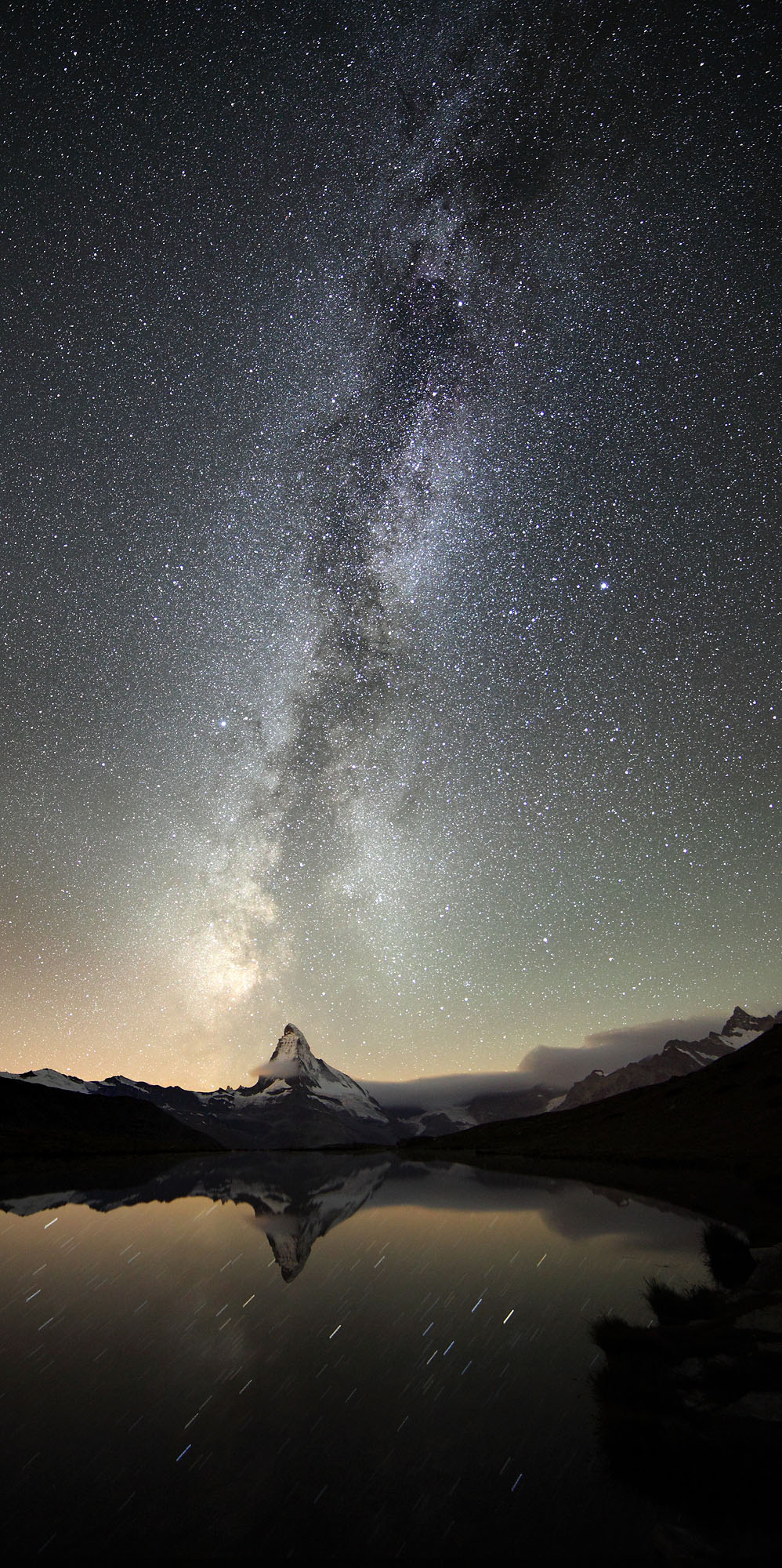
The iconic Matterhorn near Zermatt stands beneath the Milky Way, reflected in the nighttime waters of Stellisee. It is truly remarkable how this majestic landmark of Switzerland is dwarfed by the gigantic arc of the stars.
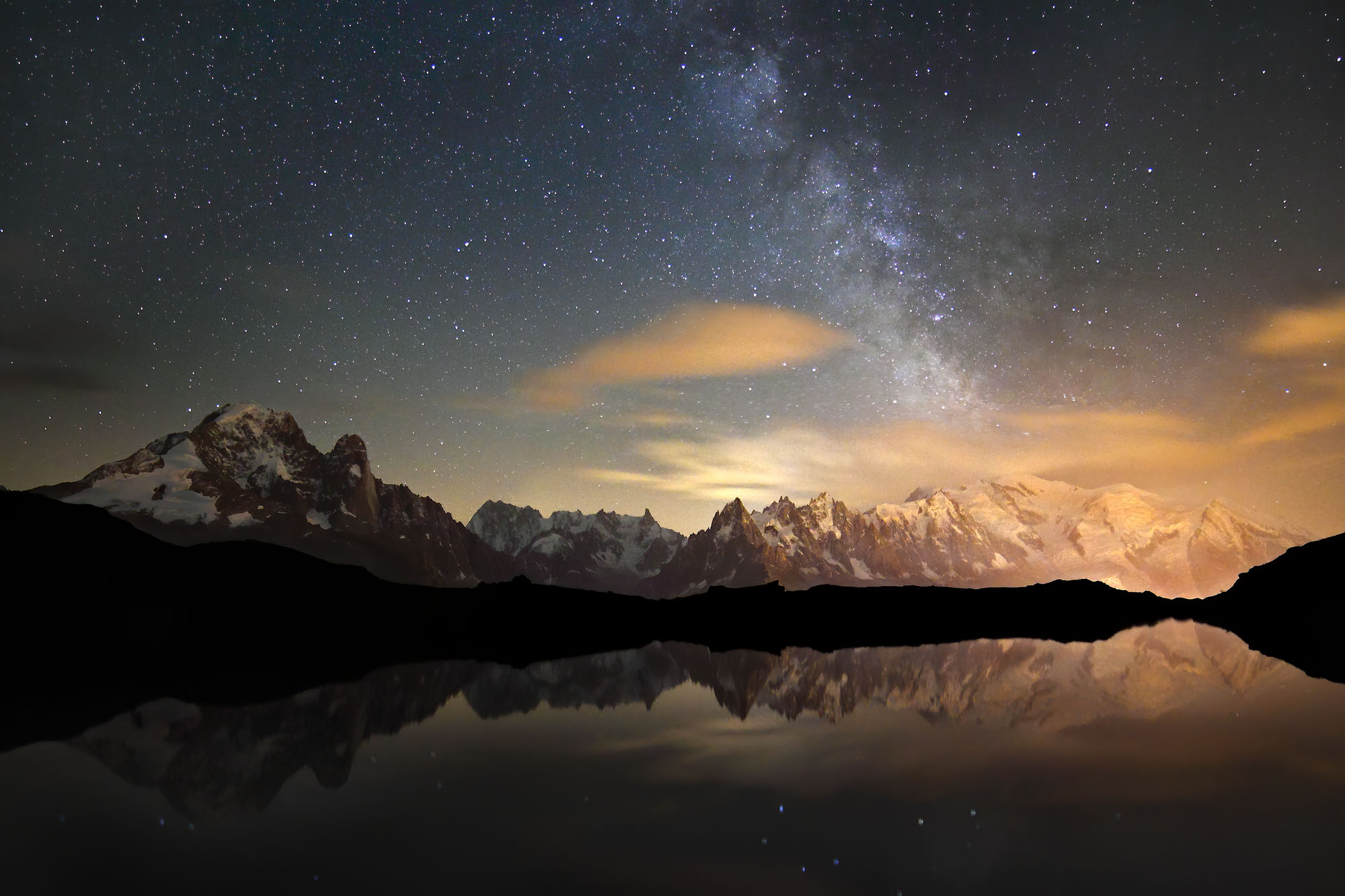
In August, around 3 a.m., the Milky Way rises above the 14,692-foot (4,478-meter) Matterhorn in the Swiss Alps. After moonset, or around the time of a new moon, millions of stars belonging to our galaxy illuminate the night sky. Capturing sharp, pinpoint stars during the four-minute exposure requires star tracking to compensate for Earth’s rotation. This makes even the faintest stars visible, greatly increasing the number of stars recorded in the image.
The reflection of the stars in the lake, however, remains as trails because the tracking movement is mirrored in the water and therefore moves in the opposite direction. This effect beautifully documents the dynamics of Earth’s rotation.
Under the vast firmament of the Milky Way, the constellations Sagittarius and Scorpius are setting below the horizon to the left and right of the Matterhorn. The Milky Way, intersected by dark clouds of interstellar dust, reveals the constellations Scutum and Ophiuchus. Just above the three bright stars visible near the center is the so-called Summer Triangle, formed by Altair in Aquila, Vega in Lyra, and Deneb in Cygnus. The constellations near the top of the image belong to Cepheus and Cassiopeia.
A night spent at Stellisee beneath the Matterhorn and its myriad stars inevitably triggers deeper thoughts about our place in the universe and the importance we attach to our daily routines.