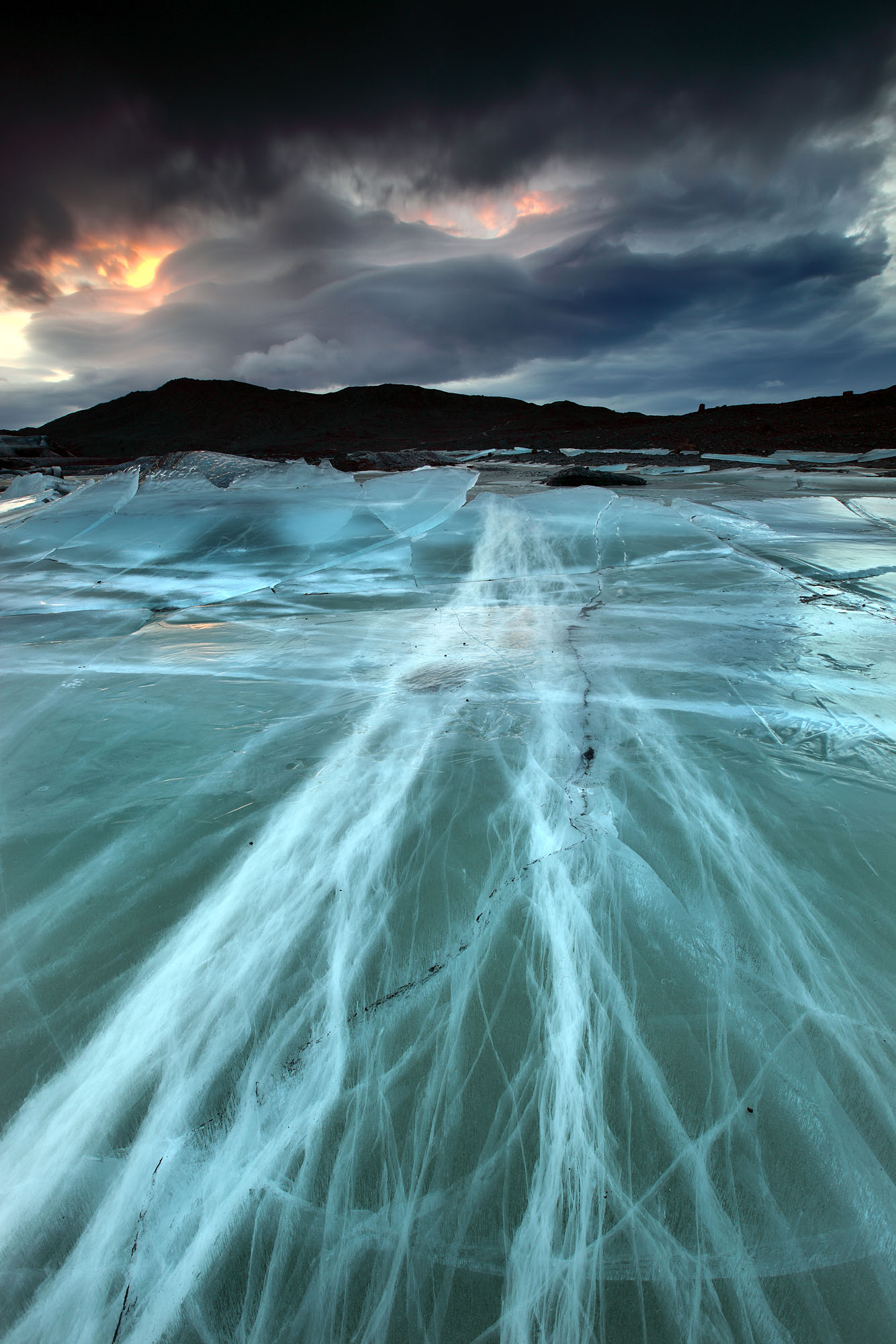
During winter, the Svínafellsjökull glacier in Skaftafell, Iceland, fills the air with loud crackling sounds as the pressurized ice of the frozen glacier lagoon strains beneath the advancing glacier. The ice of Svínafellsjökull flows steeply down toward the valley, driven by gravity at a rate of about 1 meter (3.3 feet) per day. That corresponds to an impressive movement of about 1 centimeter (0.4 inch) every 15 minutes, making the glacier’s motion remarkably easy to observe.
As the glacier advances, it presses against the up to 40-centimeter (1.3-foot) thick ice covering the adjacent frozen glacial lake. Under this immense pressure, the lake ice develops an intricate network of white lines formed by countless tension cracks, rising dramatically toward the 100-meter (330-foot) high black hills of the Svínafellsjökull terminal moraines.
The moraine wall consists of dark, angular rock debris in the form of volcanic breccia. This unsorted mixture of rock fragments has been eroded and transported by the glacier as it moves down the valley before being deposited at its terminus. The material originates from the different volcanic rocks that form the mountains beneath the Vatnajökull ice cap.
Dramatic cloud formations with scattered rays of sunlight hover above the landscape, creating constantly changing moods of light. They result from the low winter sun and broken, multilayered cloud decks. On the lee side of the ice cap, beautiful wave-shaped lenticular clouds form in the powerful airflow aloft. The indirect sunlight brings out subtle hues and soft variations in light across the icy landscape.
The constant crackling of the ice at temperatures around −8°C (18°F), combined with the ice-cold winds and impressive lenticular foehn clouds, made this experience on the glacier truly exceptional.