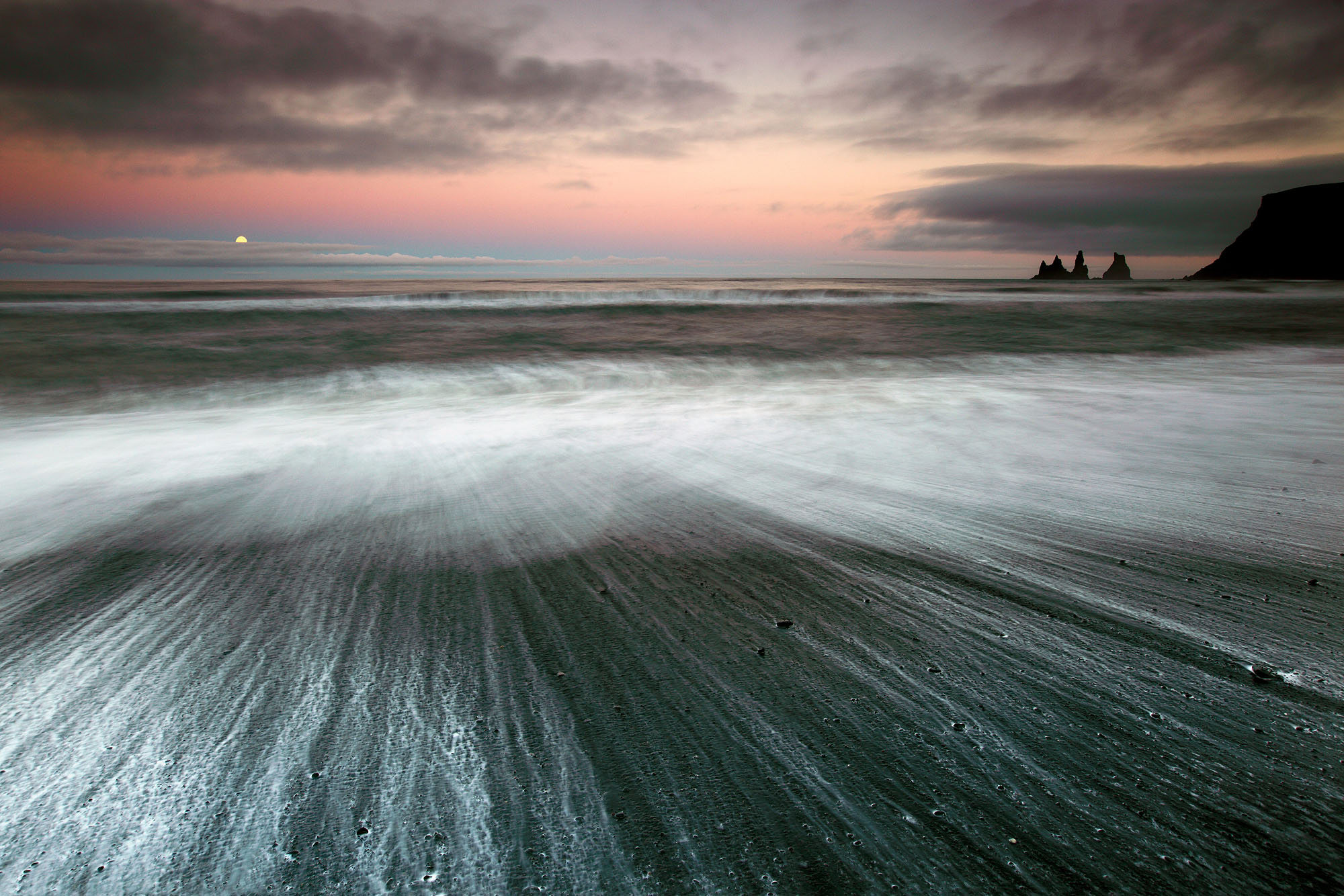
The full moon rises over the coastline of Vík í Mýrdal and the rock spires of Reynisdrangar in Iceland. At dusk, shortly before midnight in midsummer, the waves roll endlessly onto the black lava beach, sculpting magnificent patterns along the shoreline.
The fine-grained black beaches of southern Iceland consist of volcanic sand derived from eroded basalt cliffs and dikes, including the rock spires of Reynisdrangar. In addition, vast amounts of black sand originate from Jökulhlaup events. These deluge-like floods occur when volcanoes erupt beneath the ice caps and abruptly melt the ice. The resulting uncontrollable flash floods carry fine-grained volcanic ash, coarse sand, and boulders out toward the ocean.
The sandy volcanic sediment is transported along the coastline in a zigzag pattern because the incoming waves and their backwash approach the beach at different angles. Waves reach the shore obliquely, depending on the local wind direction, while the backwash flows perpendicular to the beach under the force of gravity. The resulting lateral transport of sediment is further influenced by coastal currents and tides. The full moon over Vík í Mýrdal indicates that the tide is high.
The North Atlantic around Iceland is strongly influenced by the warm Irminger Current, a recirculating branch of the Gulf Stream. This helps explain why seawater along the Icelandic coast remains above its freezing point of −1.8°C (28.8°F) throughout the year.
The volcanic foundation of Iceland does not end at its beaches. The island’s submarine rock platform extends another 90 kilometers (56 miles) offshore, where the average water depth is only 300 to 400 meters (1,000 to 1,300 feet). Beyond this platform, however, the seabed gradually descends to depths of 2,000 to 3,000 meters (6,000 to 9,000 feet).
There is something deeply special about experiencing the twilight shortly before midnight. In midsummer, the night in southern Iceland lasts barely an hour, leaving the landscape suspended between day and night.