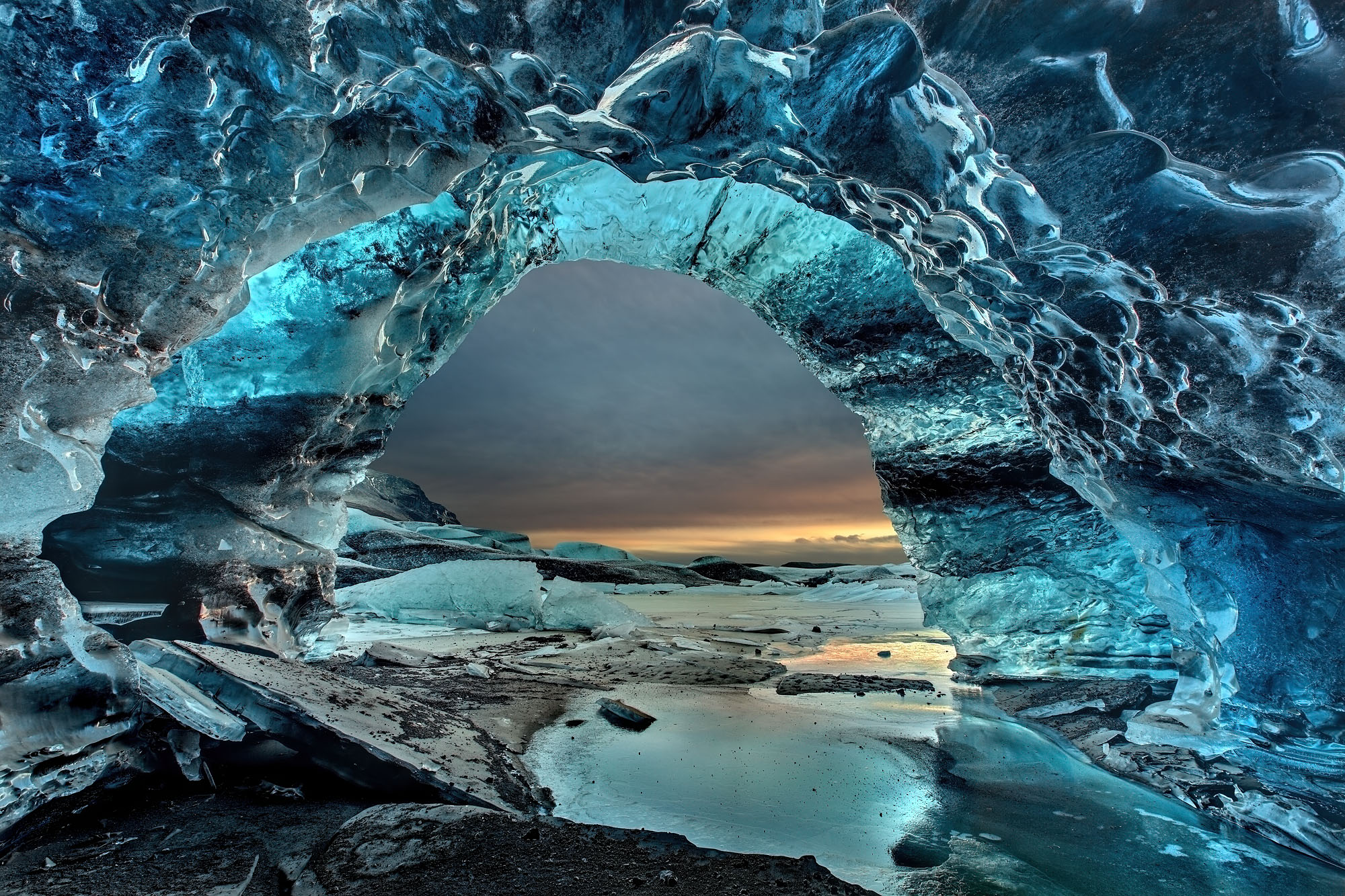
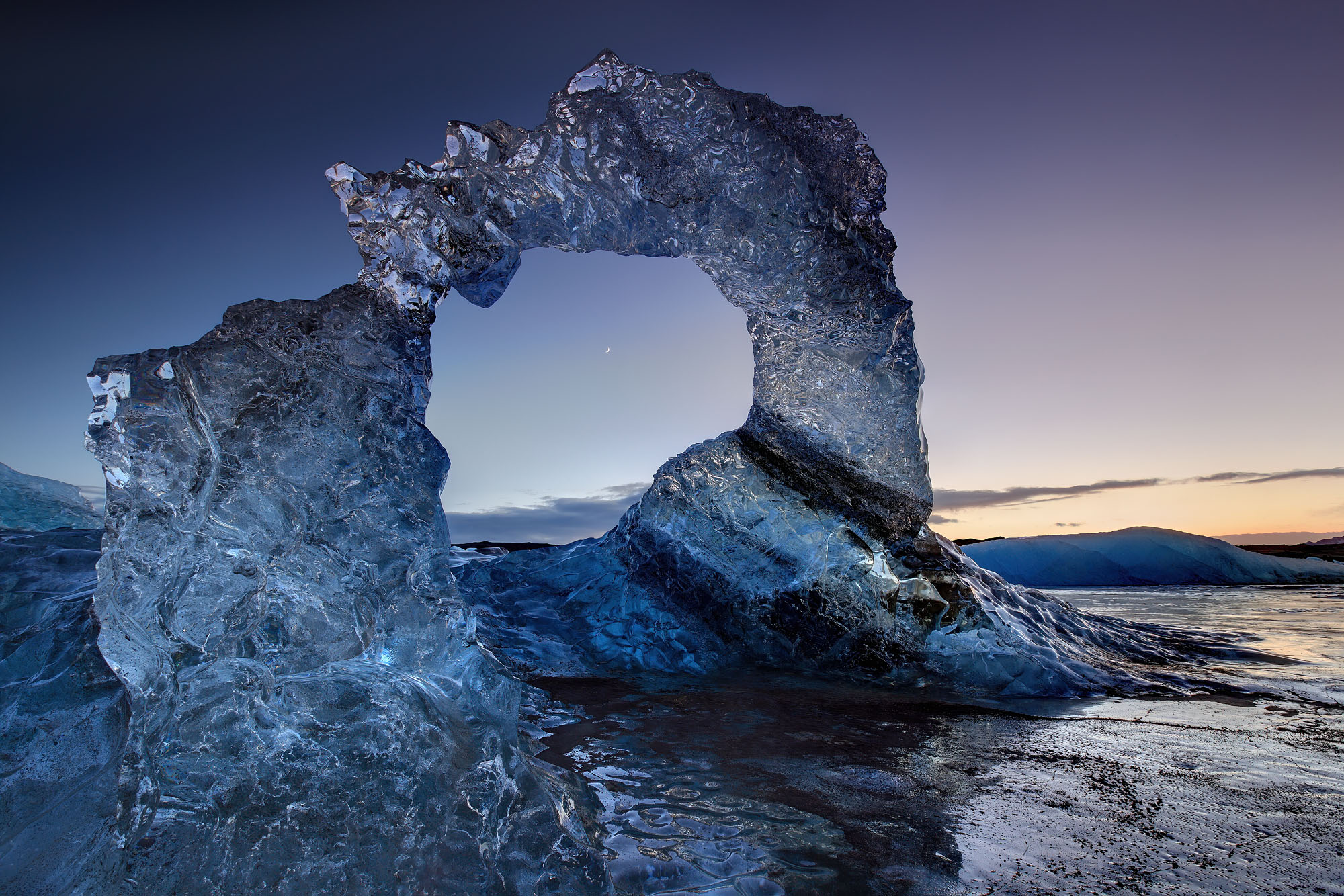
At dusk, the waxing moon peeks through a towering iceberg arch streaked with layers of black volcanic ash on the frozen glacier lagoon of Jökulsárlón in Iceland.
The northernmost parts of Iceland reach the Arctic Circle at 66° north latitude, where armadas of icebergs drift southward through the Arctic Ocean with the East Greenland Current. This ocean current approaches Iceland’s northwestern coast. The inland ice caps of Iceland receive up to 15 meters (50 feet) of snow each year. Despite these harsh Arctic conditions, Iceland’s coastal climate remains surprisingly mild and temperate throughout the year. Situated in the middle of the North Atlantic, Iceland is strongly influenced by the warm waters of the Gulf Stream. In addition, a warm recirculating branch of the Gulf Stream, the Irminger Current, flows counterclockwise around Iceland, preventing the coastal waters from freezing.
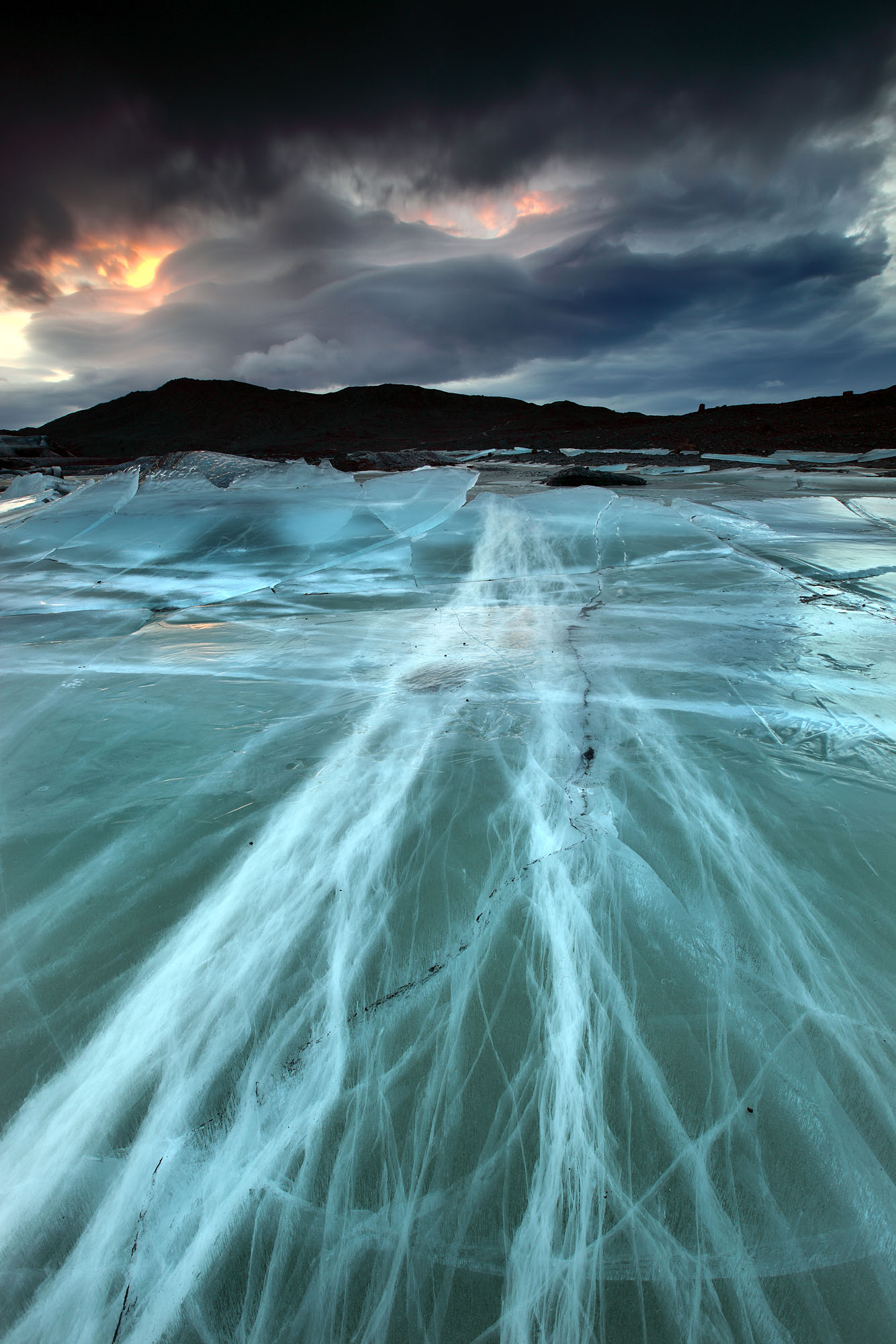
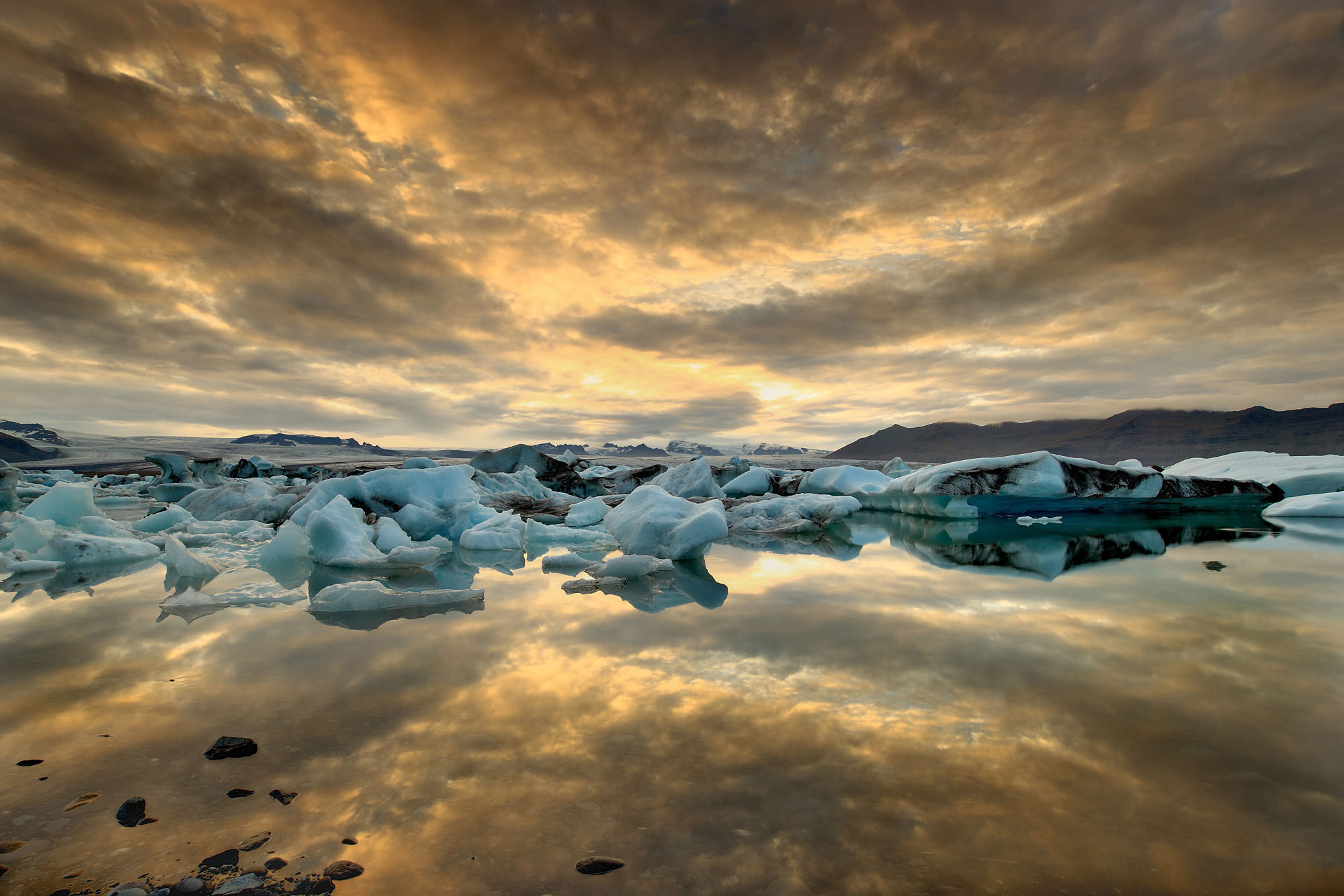
The regions surrounding Iceland’s great ice caps, however, develop their own regional climate, which can be distinctly Arctic. This is largely caused by cold winds flowing from the ice caps down into the valleys and out toward the sea. These gravity-driven katabatic winds can reach gale force and dramatically lower temperatures compared with surrounding regions. They are a major reason why the brackish waters of Jökulsárlón can freeze completely in winter, allowing direct access to the icebergs.
The frequency and intensity of these katabatic winds depend on the larger-scale atmospheric circulation. Around the Vatnajökull ice cap, this creates a regional and highly variable climate that can shift between Arctic and temperate conditions.
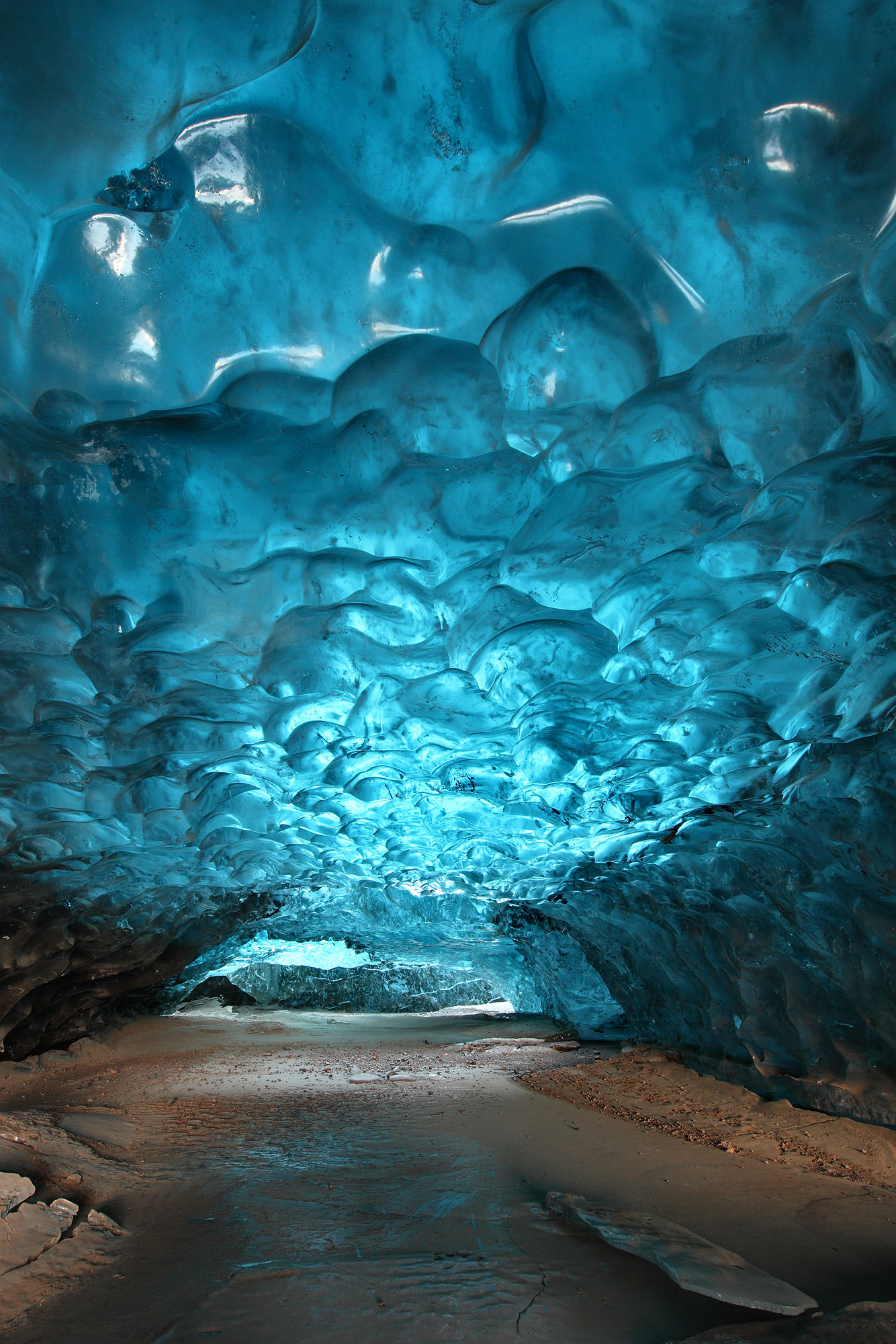
This impressive ice arch, standing 7 meters (23 feet) high, is the remnant of an ice cave through which the Breiðamerkurjökull glacier once discharged its meltwater into the glacial lagoon. The ice is about 1,000 years old and contains two distinct ash layers deposited by eruptions of Grímsvötn. One of Iceland’s most active volcanoes, Grímsvötn lies completely concealed beneath the Vatnajökull ice cap. Its collapsed crater, known as a caldera, contains a lake that remains unfrozen beneath the ice.
Eruptions of Grímsvötn can be highly explosive because the rising magma comes into contact with meltwater. When this happens, catastrophic meltwater floods known as Jökulhlaups can surge beneath and beyond the ice cap, destroying everything in their path before eventually reaching the Atlantic Ocean. The lava, meanwhile, can be fragmented into extremely fine ash and dispersed across vast areas, where it becomes incorporated into the glacier and preserved for centuries.
With the spring thaw, the tides eventually carried this gate to the Arctic out into the ocean, where it disappeared forever into the surf of the North Atlantic.