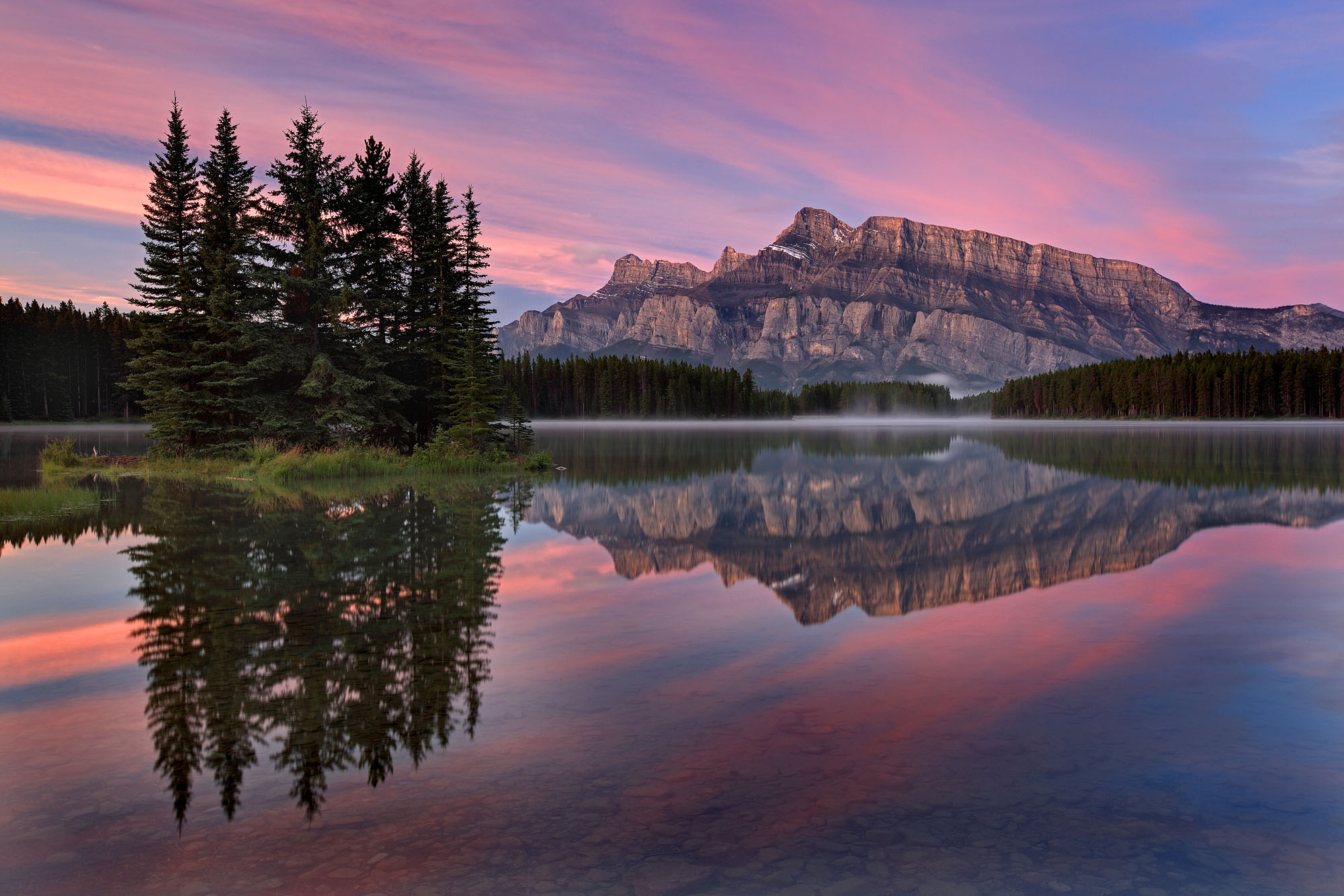
A beautiful sunrise with high cirrus clouds from an approaching storm illuminates Mount Rundle in the Canadian Rocky Mountains, reflected in Two Jack Lake near Banff. In the cold morning air, flat fog rises above the lake.
These precursor clouds signal the distant cyclone system approaching from the Pacific Ocean, which brought clouds and rain to the Canadian Rockies for several days. These mountains are geologically built up from alternating layers of limestone and shale that were deposited on an ancient ocean floor 245 to 363 million years ago. Compression of these once flat-lying layers, each up to 4,300 ft (1,300 m) thick, caused the sediments to break into huge slabs that tilted upward into a system of repeating limestone and shale patterns. Every rock exposed at the surface is subjected to the erosive forces of weathering. Shale is a soft rock compared to limestone. Hence, glaciers, precipitation, frost, and wind easily eroded the shale into deep valleys, leaving the resistant tilted limestone behind to form the Canadian Rocky Mountains we see today. These steep cliffs of Mount Rundle were formed during the Ice Age by glacial erosion and later by the erosive forces of the Bow River.
These sun rays lighting up the sky and reflecting in the lake and on the mountains in the morning quietude created a truly unforgettable moment.